

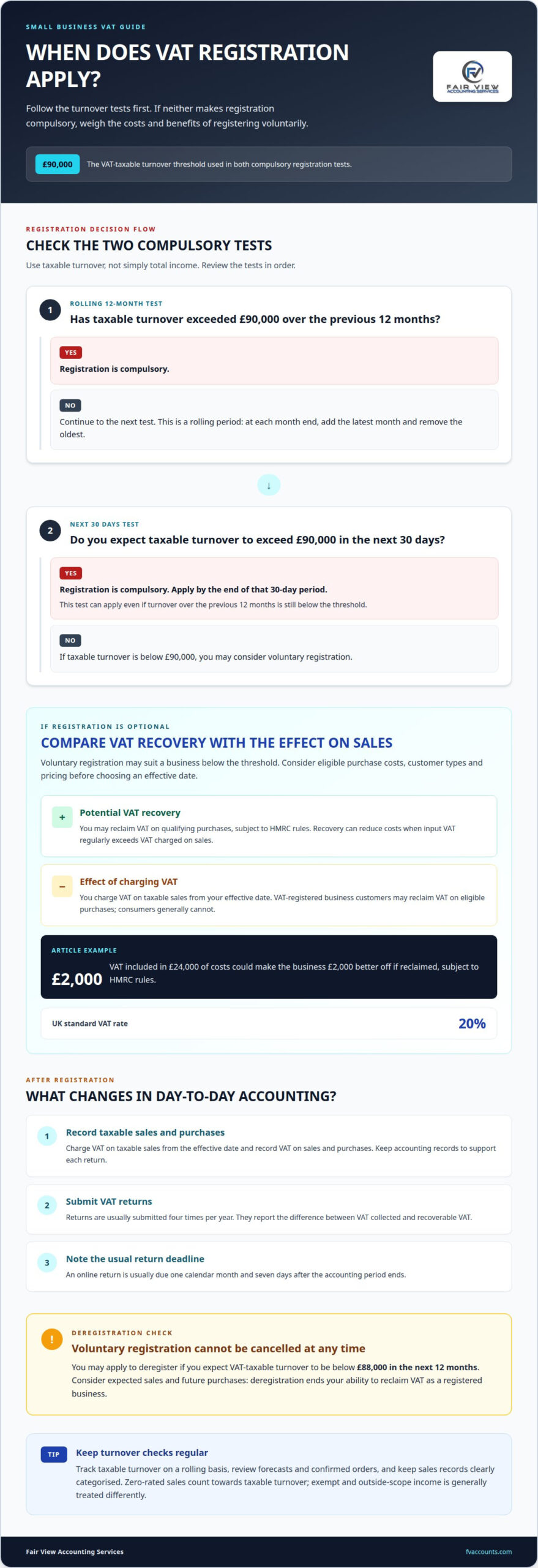
Crossing the VAT threshold isn’t the only reason to register. If you’re asking when a small business should become VAT registered, HMRC says registration is compulsory when taxable turnover exceeds £90,000 over the previous 12 months, or when you expect it to exceed £90,000 in the next 30 days.
That’s a significant decision: registration affects what you charge customers, the VAT you may reclaim on eligible purchases, and the records and returns you need to manage. Voluntary registration may suit a business below the threshold, but weigh potential VAT recovery against the effect of charging VAT on sales.
This guide explains how VAT works after registration, when voluntary registration may be worth considering, and when you may be able to deregister. It also covers practical costs, including how VAT on purchases and sales affects cash flow, so you can understand the implications before deciding what’s right for your business.
Tip: Check your turnover regularly to avoid missing the threshold.
Key Takeaways and Tips
- Weigh the VAT you could reclaim on eligible purchases against how charging VAT may affect your customers and cash flow.
- Track taxable turnover on a rolling basis so you can recognise when registration obligations may apply.
- Understand the records, invoices and returns that come with VAT registration before deciding how to manage the ongoing work.
- Prepare your business details and registration information to help a professional support the application and broader accounting needs.
Voluntary VAT registration
When should a small business become VAT registered? The answer may depend on more than whether registration is compulsory. HM Revenue & Customs says a UK business with VAT-taxable turnover below £90,000 may register voluntarily. The standard VAT rate in the UK is 20%, according to HM Revenue & Customs.
Benefits of registering voluntarily
Voluntary registration can allow a business to reclaim VAT on qualifying purchases, reducing costs when its input VAT regularly exceeds VAT charged on sales. For example, £24,000 of costs may include £2,000 VAT; reclaiming it could make the business £2,000 better off, subject to HMRC rules.
When should a small business become VAT registered voluntarily? Consider whether potential VAT recovery outweighs the effect of charging VAT to customers. VAT-registered business customers may reclaim VAT on eligible purchases, but consumers generally cannot. Compare purchase costs, customer types, and pricing before choosing an effective date. Keep accounting records to support each return.
Having a professional register your business with HMRC
An accountant can prepare and submit the VAT application online, whether registration is voluntary or compulsory. Most UK businesses need their Unique Taxpayer Reference (UTR). Provide the UTR and accurate details of your trading activity and taxable turnover so the application reflects the correct registration basis and effective date.
A professional can also organise records and assess which earlier purchases may qualify for recovery. A newly registered business may be able to reclaim VAT on qualifying goods bought up to four years before registration if it still has them, and qualifying services bought up to six months before registration, subject to HMRC rules.
Voluntary deregistration
Voluntary registration does not mean a business can cancel at any time. It may apply to deregister if it expects VAT-taxable turnover to be below £88,000 in the next 12 months. Before applying, consider expected sales and future purchases, since deregistration ends the ability to reclaim VAT as a registered business.
How does VAT work once my business is VAT registered?
VAT registration affects pricing, invoices, accounting and cash flow. An accountant monitors taxable turnover each month, rather than relying only on annual accounts. They review sales records and distinguish taxable supplies from exempt or outside-scope income. This gives an early view of whether registration is approaching and which circumstances affect the calculation.
The rolling 12-month test compares taxable turnover across the latest 12 months, not just a financial year. At each month end, the accountant adds the latest month and removes the oldest. Zero-rated sales count towards taxable turnover, while exempt and outside-scope income is generally treated differently. Accurate categorisation helps prevent turnover being understated or overstated.
A separate test considers expected taxable turnover in the next 30 days. HM Revenue & Customs says a UK business expecting to exceed the VAT threshold in the next 30 days must apply by the end of that 30-day period. This test can apply even when turnover over the previous 12 months remains below the threshold. An accountant reviews forecasts, confirmed orders and expected supplies to identify this trigger.
Once registered, the business charges VAT on taxable sales from its effective date and records VAT on sales and purchases. It submits VAT returns, usually four times per year, and reports the difference between VAT collected and recoverable VAT. HM Revenue & Customs says an online return is usually due one calendar month and seven days after the accounting period ends. A professional can coordinate turnover monitoring with support with VAT returns and registration, helping keep reporting aligned with the business’s records.
How can a professional register my business for VAT with HMRC, and what information do you need from me?
An accountant can prepare and submit a VAT application online to HMRC, whether registration is voluntary or compulsory. Most UK businesses need their Unique Taxpayer Reference (UTR) to register. The accountant uses this identifier alongside your business information to prepare an accurate application and clarify the basis for registration.
To prepare the application, the accountant reviews your business details and accounting records. You’ll need to provide your UTR and information about your trading activity and taxable turnover. Sales records help establish whether registration is compulsory, while forecasts can support an application based on expected turnover. Clear, consistent information helps assess the appropriate registration basis.
Depending on your circumstances, the accountant may organise information such as:
- Your UTR and business identification details.
- Sales records showing taxable supplies and turnover.
- Relevant forecasts and the intended effective date.
The accountant then prepares the application using the information provided, submits it to HMRC, and helps you understand what follows. The effective date matters because it determines when VAT obligations begin. Accurate records also help connect the registration details with your bookkeeping and prepare for VAT reporting. Keep information current, especially if your trading activity or expected sales change while the application is being prepared.
Fair View Accounting Services: Accountants for start up businesses
Fair View Accounting Services supports start-ups with their accounting needs as they assess VAT registration and plan for growth. Consider professional support when turnover is changing, registration rules are unclear, or VAT responsibilities need to fit alongside your wider accounting.
Coordinating VAT decisions with Annual Accounts and Corporation Tax can help keep financial records organised and clarify your business obligations. An Accountant’s Certificate may also be relevant when you need formal accounting documentation. The right support depends on your business needs.
Keep sales and purchase records current, and share relevant business information with your accountant. This makes it easier to discuss how VAT registration may affect your accounting as your start-up develops.
If you’d like to discuss your accounting needs, contact Fair View Accounting Services.
Plan your next step with confidence
Knowing when a small business should become VAT registered is one part of sound financial planning. The next is ensuring VAT decisions support how you price, purchase, and grow. Treat registration as an ongoing business consideration, not an isolated form-filling exercise.
A useful next step is to discuss your sales outlook, purchasing plans, and customer mix with an accountant. Considering these together puts VAT decisions in the context of daily operations and wider business priorities. Keep key records organised so discussions can focus on decisions rather than reconstructing past activity.
Professional accounting support can also help connect VAT considerations with your wider financial administration as the business develops. With a clear plan and organised information, you can approach the next stage with greater confidence and make informed decisions that fit your goals.
Take the next step at a pace that works for your business.
Frequently Asked Questions
What are the benefits of being VAT registered?
VAT registration can make a difference when a business regularly pays VAT on stock, equipment, or other eligible business purchases. Reclaiming eligible input VAT can reduce the net cost of those purchases. Registration may also have less impact on pricing when customers are VAT registered and can reclaim VAT on eligible purchases. Consider your customer mix and spending patterns together.
Are there any disadvantages of being VAT registered?
Yes. A business may need to charge VAT on taxable sales, which can raise the amount consumers pay if prices are increased to account for it. Registration also brings record-keeping and return responsibilities. For example, a small retailer selling mainly to individual customers may need to consider how VAT affects shelf prices, margins, and customer demand.
Need help deciding when to register for VAT?
An accountant can assess your sales pattern, expected orders, customer types, and VAT-bearing purchases to help you weigh compulsory and voluntary registration. Fair View Accounting Services supports businesses in Manchester, Bolton, Bury, Lancashire, and London, including with VAT Returns. Bring current sales and purchase records to the discussion so the advice reflects your trading activity, not turnover alone.
Can you reclaim VAT from before you registered?
You may be able to reclaim VAT on qualifying goods bought up to four years before registration if you still have them, and qualifying services bought up to six months beforehand, subject to HMRC rules. Keep purchase invoices and records that identify the goods or services. The eligibility conditions matter, so older purchases do not qualify automatically.
Do I have to register for VAT even if I’m a sole trader?
Yes, sole trader status does not remove the VAT registration requirement. HM Revenue & Customs requires a UK business to register if its taxable turnover exceeds £90,000 over the previous 12 months, or if it expects to exceed £90,000 in the next 30 days. The tests concern taxable turnover and expected trading, not whether the business is incorporated.
Disclaimer
The information provided in this article is for general guidance only and is not intended to constitute professional advice, tax advice, financial advice, legal advice, or any other form of regulated guidance. Although every effort has been made to ensure accuracy at the time of publication, Fair View Accounting Services, including its director, employees, contractors, writers, and content-creation team, accepts no responsibility for any loss, damage, penalty, or consequence arising from reliance on the information contained herein.
UK tax legislation changes frequently, and HMRC interpretations, thresholds, and rules may vary depending on the individual circumstances of each taxpayer. Nothing in this article should be considered a substitute for obtaining formal, personalised advice from a qualified accountant or tax professional. Readers should not take action or refrain from taking action based solely on the content published on this website.
Fair View Accounting Services does not guarantee the completeness, accuracy, or ongoing validity of the information provided and assumes no liability for omissions or errors, whether typographical, factual, or technical. By using this content, the reader acknowledges that all responsibility for decisions remains solely with the user.