
A business purchase can qualify for tax relief, but the type of asset and how it’s used both matter. If you need the annual investment allowance explained in plain English, this guide sets out which plant and machinery may qualify and how the relief works. HM Revenue & Customs says the annual limit was increased to £1,000,000 in January 2019, and the change is permanent.
It can be tempting to assume every business purchase qualifies. For anyone looking to have the annual investment allowance explained clearly, the key distinction is between eligible plant and machinery and items such as business cars or assets owned before they were used for the business.
This guide explains how the allowance works, which purchases may qualify and when other capital allowances may apply. It also covers practical details that can affect a claim, including business use and the accounting period in which you buy an item. Tip: check whether an item is eligible before claiming.
Key Takeaways
- Identify whether a purchase is qualifying plant or machinery before including it in a capital allowance claim.
- HM Revenue & Customs says a qualifying business asset can have 100% of its cost deducted from business profit under the Annual Investment Allowance.
- Separate business use from private use, and note whether an asset was already owned or is a car, as these details can affect eligibility.
- Keep purchase and accounting-period records organised so the claim can be included in the relevant tax return.
What is the Annual Investment Allowance?
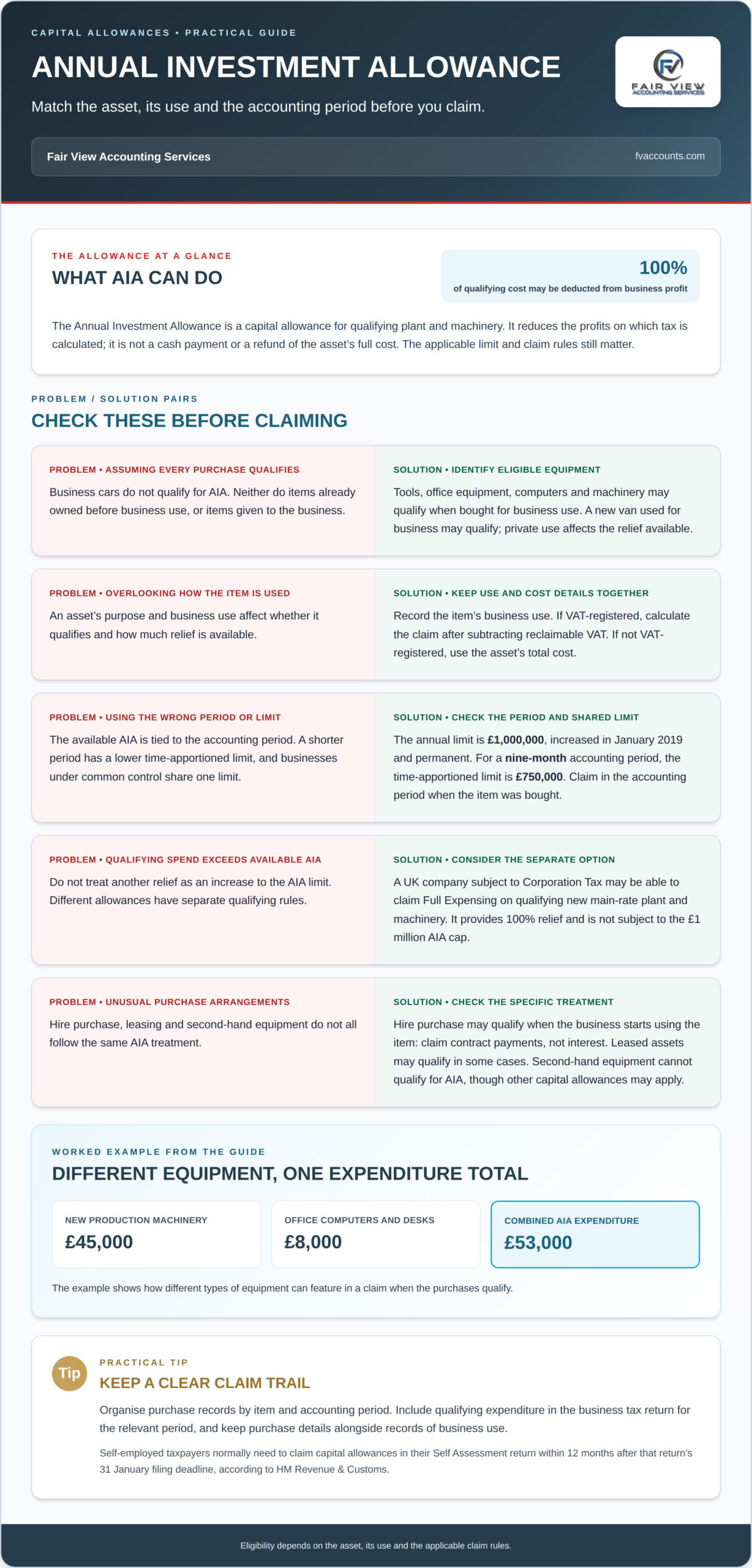
The Annual Investment Allowance (AIA) is a capital allowance that lets eligible businesses deduct the cost of qualifying plant and machinery from taxable profits. This provides tax relief on eligible expenditure, subject to the applicable limit and claim rules.
AIA limits and accounting periods
The AIA limit caps the qualifying expenditure a business can claim under this allowance in an accounting period. HM Revenue & Customs says the annual limit was increased to £1,000,000 in January 2019, and the change is permanent. A business with a nine-month accounting period has its annual limit time apportioned to £750,000, according to HM Revenue & Customs.
This matters when accounting dates change or an accounting period is shorter than usual. For example, the limit for a nine-month period is lower than the full annual limit, so using the wrong period could overstate the allowance available. Claim AIA in the accounting period when the item was bought. Group companies and businesses under common control share one limit rather than receiving a separate full limit each.
Claiming AIA on a tax return
Claim AIA by including qualifying expenditure in the business’s tax return for the relevant accounting period. Organise purchase records by item and period so the return shows when each purchase was made and how much expenditure is claimed.
Self-employed taxpayers normally need to claim capital allowances in their Self Assessment return within 12 months after that return’s 31 January filing deadline, according to HM Revenue & Customs. Common mistakes include claiming in the wrong period, overlooking a shared group limit, or treating every purchase as eligible. A further risk is claiming the full cost without considering whether another allowance could suit the business better.
Spending above the AIA limit
When qualifying expenditure exceeds the available AIA limit, a UK company subject to Corporation Tax may be able to claim Full Expensing on qualifying new main-rate plant and machinery. This annual allowance provides 100% relief and is not subject to the £1 million AIA cap. Full Expensing is a separate option, not an increase to the AIA limit. Compare the eligible expenditure and accounting-period limits before deciding which allowance to claim.
Qualifying plant and machinery
AIA may apply to qualifying business equipment, but ownership, use and purchase arrangements matter. HM Revenue & Customs says a qualifying business asset can have 100% of its cost deducted from business profit when calculating tax under the Annual Investment Allowance annually.
Qualifying expenditure on plant and machinery
Qualifying expenditure is the amount spent on eligible plant and machinery for business purposes. Tools, office equipment, computers and machinery may qualify when bought for business use. The asset’s purpose matters: business cars do not qualify for AIA, nor do items owned before business use or given to the business. Keep purchase details and records of business use together to support the capital allowances claim.
Assets eligible for capital allowances
Capital allowances apply to qualifying tangible assets used in a business, such as equipment that helps deliver its work. A qualifying asset usually provides a lasting business benefit beyond a year. A new van used for business may qualify, while private use affects the relief available. A VAT-registered business calculates its claim after subtracting reclaimable VAT; a business that is not VAT-registered uses the asset’s total cost.
Businesses subject to Corporation Tax or Income Tax can claim AIA, with exceptions including trustees and mixed partnerships of individuals and companies. A partnership can claim only if all its members are individuals.
If an asset is sold after AIA has been claimed, its sale proceeds may need to be included in the tax calculation as a balancing charge. When a business closes, the tax treatment of asset purchases in its final accounting period may differ. Instead, it reports a balancing charge or allowance for the year of closure.
Hire purchase can qualify when the business starts using the item: the claim can cover contract payments, but not interest. Leased assets may qualify in some cases, while second-hand equipment cannot qualify for AIA, though other capital allowances may apply. For help reflecting qualifying purchases in your accounts, discuss your asset records.
What the Annual Investment Allowance is
The Annual Investment Allowance is a capital allowance for qualifying business expenditure. It lets a business deduct eligible plant and machinery costs from taxable profits, reducing the profits on which tax is calculated. It is not a cash payment or a refund of the asset’s full cost. The relief is applied through the business’s tax calculation.
For businesses wanting the annual investment allowance explained in practical terms, it helps to distinguish capital expenditure from ordinary running costs. A worked example uses £45,000 of new production machinery and £8,000 of office computers and desks. Together, those purchases make £53,000 of AIA expenditure, illustrating how different types of equipment can feature in a claim.
Businesses do not have to claim an asset’s full cost through AIA. A partial claim can leave the remaining expenditure eligible for writing down allowances, which provide relief over time. This can matter when planning how expenditure affects taxable profits across accounting periods. The decision depends on the business’s wider financial position, not just the purchase price.
To have the annual investment allowance explained in context, consider the asset type before choosing a claim. AIA applies to plant and machinery, not every asset or expense. Business cars are excluded, although new and unused cars with zero CO₂ emissions may qualify for a 100% annual first-year allowance. Keep purchase and asset details together to support the accounting treatment.
For a clear record of how capital expenditure affects your accounts, discuss your annual accounts.
Fair View Accounting Services: Annual Accounts
Fair View Accounting Services prepares Annual Accounts and supports Corporation Tax reporting, helping you keep business figures organised alongside capital expenditure decisions. This support is useful when equipment purchases, asset sales or changes in business use need to be reflected in your accounts and tax records.
Accurate records link invoices and asset details to the relevant accounting period. This is useful when assessing whether an item may qualify for capital allowances or preparing figures for a Corporation Tax return. Fair View Accounting Services also provides an Accountant’s Certificate when a formal certificate is needed for a specific purpose.
Contact Fair View Accounting Services to discuss your Annual Accounts and Corporation Tax needs.
Plan your next business investment with confidence
A clear explanation of the annual investment allowance can help you make informed decisions before buying new equipment. Consider how the purchase meets your business needs, how the asset will be used and how its tax treatment fits with your wider accounts. Keep invoices, payment details and asset records together to simplify later reporting, particularly if circumstances change or you sell an asset.
Fair View Accounting Services can help bring asset transactions and tax reporting into a clear accounting picture. If you’re planning a purchase or preparing your records, the next step is to discuss the support that fits your business and circumstances.
Clear records and considered decisions give you a better view of how business investment fits your financial plans.
Frequently Asked Questions
What Qualifies for AIA?
Most plant and machinery bought for business use may qualify, provided it meets the allowance rules. Start by checking whether the purchase is equipment used in the business, rather than a car or an asset previously owned privately. For items with both business and private use, only the business-use proportion may count towards capital allowances.
What are capital allowances?
Capital allowances are tax deductions for qualifying business assets, recognising their cost when taxable profits are calculated. They cover eligible plant and machinery, with different relief applying to different assets. For example, cars and second-hand equipment may receive relief through allowances spread over time rather than an immediate AIA deduction. The treatment depends on the asset type and its use.
Can I claim AIA on a company car?
No, business cars are excluded from AIA, even when the company owns and uses the vehicle. A new, unused car with zero CO₂ emissions may instead qualify for a 100% annual first-year allowance. Other cars may receive capital allowances based on their emissions and the relevant pool. Keep vehicle purchase and business-use details to support the appropriate claim.
Do I have to claim the full AIA?
No. A business can claim only part of an asset’s cost through AIA. The remaining balance may qualify for writing down allowances, which spread relief over time. This can help a business manage how expenditure affects taxable profits across accounting periods. Record both the amount claimed and the balance carried forward for later allowance calculations.
How does AIA work?
AIA lets eligible businesses claim qualifying plant and machinery expenditure against taxable profits, subject to the limit for the relevant accounting period. Make the claim for the period in which the item was bought. For a hire purchase agreement, the claim may cover contract payments once the business starts using the item, but not interest.
Disclaimer
The information provided in this article is for general guidance only and is not intended to constitute professional advice, tax advice, financial advice, legal advice, or any other form of regulated guidance. Although every effort has been made to ensure accuracy at the time of publication, Fair View Accounting Services, including its director, employees, contractors, writers, and content-creation team, accepts no responsibility for any loss, damage, penalty, or consequence arising from reliance on the information contained herein.
UK tax legislation changes frequently, and HMRC interpretations, thresholds, and rules may vary depending on the individual circumstances of each taxpayer. Nothing in this article should be considered a substitute for obtaining formal, personalised advice from a qualified accountant or tax professional. Readers should not take action or refrain from taking action based solely on the content published on this website.
Fair View Accounting Services does not guarantee the completeness, accuracy, or ongoing validity of the information provided and assumes no liability for omissions or errors, whether typographical, factual, or technical. By using this content, the reader acknowledges that all responsibility for decisions remains solely with the user.