

What if your year-end accounts could reveal as much about the year ahead as they do about the year just gone? A year-end accounting checklist for SMEs helps bring the records behind the figures into focus. Accurate, complete accounts give you a clearer view of business performance and a stronger basis for decisions.
Year-end can feel like a paperwork exercise, but a careful review can uncover missing records, unusual balances and figures that need attention. This guide explains why year-end accounts matter and what an accountant reviews, from fixed assets and loans to significant balances and financial reports. Tip: Keep supporting documents organised throughout the year, so figures are easier to trace back to the evidence behind them.
Key Takeaways
- Reconcile transactions and supporting records to spot missing documents, duplicated entries and balances that need attention.
- Review fixed asset additions, disposals and depreciation, and make sure significant loan balances are supported by clear records.
- Use year-end reports to assess revenue, expenses and cash flow against the previous financial year.
- Keep records organised and provide clear supporting documents to help an accountant prepare accurate annual accounts.
Why Are Year-End Accounts Important for Small Businesses?
Accurate year-end accounts help confirm that bookkeeping records are complete before filing. An accountant matches bank, credit card and payment platform transactions with invoices, receipts and statements, then investigates unmatched items, duplicate entries and unexplained differences.
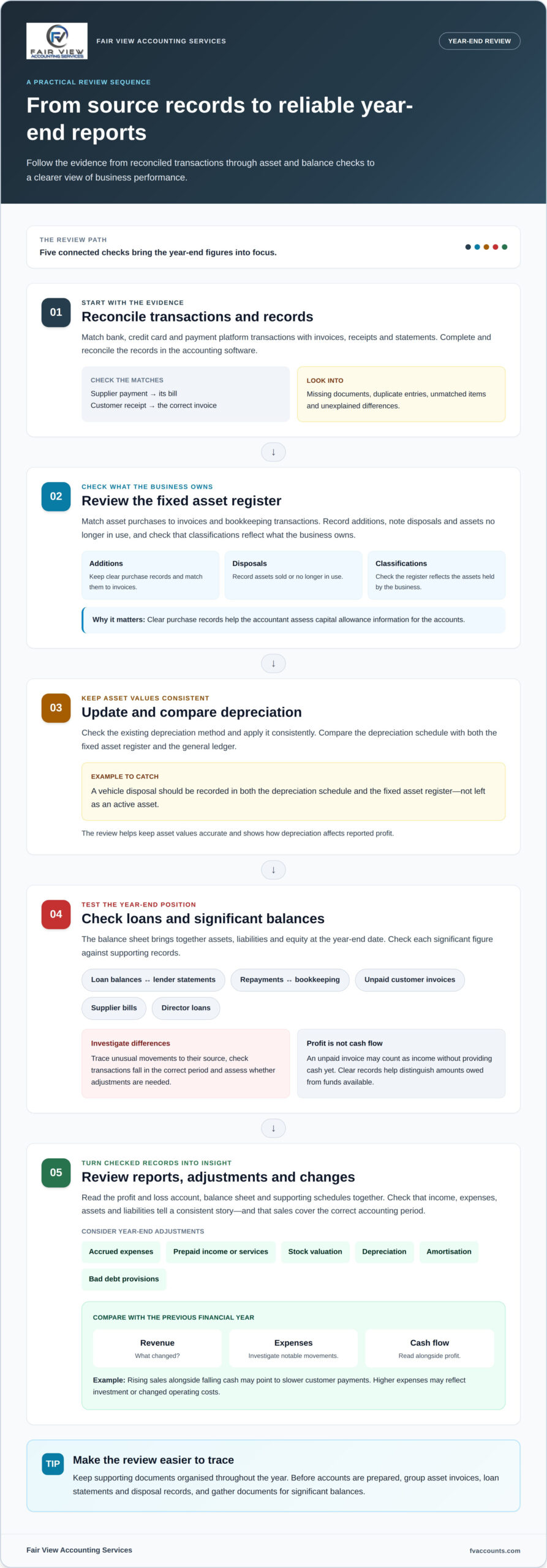
The accountant also completes and reconciles records in the accounting software. For example, a supplier payment is matched to its bill, and a customer receipt to the correct invoice. This gives you a clearer view of income, expenses and outstanding balances.
For a UK private limited company, statutory accounts are generally due at Companies House within nine months of the financial year-end, according to Companies House. HM Revenue & Customs (HMRC) says a company’s Company Tax Return is normally due 12 months after its Corporation Tax accounting period ends. Corporation Tax is usually payable nine months and one day after that period ends, according to HMRC.
Sole traders and partners must submit digital Self Assessment returns and pay any tax due by 31st January, according to HMRC. HMRC also says employees on payroll on 5 April must receive a P60 by 31 May. An accountant can match payroll figures with payslips, pension records and director-loan balances.
Expense records should identify business purchases and retain supporting documents; asset information helps an accountant assess capital allowance information. The dividend allowance is £500 for the 2025/26 tax year. Late Companies House accounts can incur penalties from £150 to £1,500, depending on the delay. HMRC return filing and tax payment deadlines are separate, so an accountant tracks them individually.
If your business holds stock, an accountant can compare stocktake records with inventory balances and flag obsolete or damaged items. This year-end accounting checklist for SMEs helps organise the records and reconciliations needed before the accounts are finalised.
Reviewing fixed assets, loans and significant balances
Start with the fixed asset register, matching purchases to invoices and bookkeeping transactions. Record each addition, note assets that have been disposed of or are no longer in use, and check that classifications reflect what the business owns. Clear purchase records also help the accountant assess capital allowance information for the accounts.
Next, update the depreciation schedule. Check the business’s existing method and apply it consistently, then compare the schedule with the fixed asset register and general ledger. For example, a vehicle disposal should be recorded in both, rather than left as an active asset. This review helps keep asset values accurate and shows how depreciation affects reported profit.
The balance sheet brings together assets, liabilities and equity at the year-end date. Compare loan balances with lender statements, check repayments and investigate any differences in the bookkeeping. Review significant balances, such as unpaid customer invoices, supplier bills and director loans, against supporting documents. This helps distinguish amounts the business owes from funds available to it.
Accurate balances matter because profit and cash flow describe different things: an unpaid invoice may count as income without providing cash yet. Accountants trace unusual movements to their source, check that transactions fall in the correct period, and assess whether adjustments are needed. A tip for a smoother review is to organise asset invoices, loan statements and disposal records together before accounts are prepared. To discuss a professional review of your year-end asset and balance records, contact Fair View Accounting Services.
Year-end financial reports
Year-end reports turn reconciled records into a clear picture of performance and financial position. Review the profit and loss account, balance sheet and supporting schedules together, so income, expenses, assets and liabilities tell a consistent story. For example, sales in the ledger should agree with the underlying invoices and cover the correct accounting period.
Correct figures also depend on reviewing adjustments. Consider accrued expenses, prepaid income or services, stock valuation, depreciation, amortisation and bad debt provisions. A supplier invoice received after year-end, for example, may relate to work completed before it; the accountant assesses which period it belongs in. Missing adjustments can distort both profit and the balance sheet.
Performance reports are more useful when compared with previous results. Compare revenue, expenses and cash flow with the previous financial year, then investigate notable movements. Rising sales alongside falling cash may point to slower customer payments, while higher expenses may reflect investment or changed operating costs. These comparisons help directors understand what changed, rather than relying on profit alone.
For UK limited companies, statutory accounts are generally due at Companies House within nine months of the financial year-end. A director’s report is not always mandatory. Your accountant considers the company’s reporting requirements, prepares the relevant statements and plans submissions around filing deadlines. Before approving draft reports, investigate any unexplained differences between the balance sheet and bookkeeping. Clear schedules make adjustments easier to trace and support accurate reporting.
Fair View Accounting Services
Fair View Accounting Services helps SMEs turn year-end bookkeeping and supporting records into clear, complete accounts. Its Annual Accounts and Corporation Tax services support businesses with reporting and filing, while its Accountant’s Certificate service meets relevant certification needs.
Consider professional support if asset records, loan balances or year-end adjustments are difficult to reconcile, or if you want an accountant to prepare and review your accounts. Organised invoices, statements and bookkeeping records give the accountant useful evidence to work from. Gather documents for significant balances before accounts preparation begins.
Contact Fair View Accounting Services to discuss support with your year-end accounts.
Build a steadier year-end process
Turn the year-end accounting checklist for SMEs into a recurring handover routine, rather than leaving evidence gathering until accounts are due. Assign responsibility for key records, keep a consistent filing structure and note questions as transactions occur. This makes future reviews easier to manage and helps you base business decisions on organised information.
Set a regular time to review how the process is working. If balances remain difficult to explain or reporting takes attention away from running the business, professional support can help establish a workflow suited to your records. Start with the area causing the most uncertainty, then gather the documents and context needed to address it.
A clear process makes the next year-end more manageable, one well-kept record at a time.
Frequently Asked Questions
Why is year-end closing so difficult?
Year-end closing brings several record-keeping tasks together, often while normal business continues. Transactions near the reporting cut-off can be difficult to assign to the correct period, particularly when an invoice arrives after the work is completed. Tip: Keep a running list of unresolved items during the year, such as disputed bills or receipts awaiting evidence.
Are end-of-year accounts figures exclusive of VAT?
Not necessarily. Check how the accounts report presents VAT and how each transaction is treated. VAT-inclusive totals can differ from the income or expense figures used in financial reporting. For example, a report may show a customer payment including VAT, while presenting the sales figure separately. Tip: Ask your accountant to clarify the report basis before comparing it with bank receipts.
Can an accountant or external provider help with year-end bookkeeping?
Yes. An accountant can organise and review bookkeeping records, investigate unclear entries and prepare information for year-end reporting. This can help when the person maintaining the books has limited time or software records need tidying before accounts are prepared. Fair View Accounting Services provides bookkeeping support to SMEs in Bolton, Bury, Lancashire, Manchester and London.
Do sole traders and limited companies follow the same year-end bookkeeping process?
No. Both business types need records supporting income and expenses, but their reporting requirements differ. A sole trader’s accounts relate to the owner’s business activity, while a limited company prepares its accounts separately from its directors’ personal finances. Tip: Ensure the year-end review reflects the entity’s reporting requirements.
How can an accountant help make the next year-end easier?
An accountant can identify recurring gaps in your records and help establish a consistent bookkeeping routine for the next period. For example, they can recommend ways to file invoices, record explanations for unusual transactions and keep payroll documents together. Fair View Accounting Services uses cloud-based platforms including QuickBooks, Xero, IRIS and Dext to provide online accounting support.
Disclaimer
The information provided in this article is for general guidance only and is not intended to constitute professional advice, tax advice, financial advice, legal advice, or any other form of regulated guidance. Although every effort has been made to ensure accuracy at the time of publication, Fair View Accounting Services, including its director, employees, contractors, writers, and content-creation team, accepts no responsibility for any loss, damage, penalty, or consequence arising from reliance on the information contained herein.
UK tax legislation changes frequently, and HMRC interpretations, thresholds, and rules may vary depending on the individual circumstances of each taxpayer. Nothing in this article should be considered a substitute for obtaining formal, personalised advice from a qualified accountant or tax professional. Readers should not take action or refrain from taking action based solely on the content published on this website.
Fair View Accounting Services does not guarantee the completeness, accuracy, or ongoing validity of the information provided and assumes no liability for omissions or errors, whether typographical, factual, or technical. By using this content, the reader acknowledges that all responsibility for decisions remains solely with the user.