

What if your company has two different deadlines after its year end? Filing final accounts for a limited company means preparing accounts for Companies House and a Company Tax Return for HMRC. According to Companies House, a UK private limited company must file its annual accounts within 9 months after its financial year ends. According to HM Revenue & Customs, the Company Tax Return is due within 12 months of the end of the relevant accounting year.
It’s easy to focus on one deadline and overlook the other. Your company’s year end is the starting point for working out both, so identify it early to plan the filing process and reduce the risk of late penalties. Tip: note both deadlines in your calendar.
This guide explains how to find your year end, what to prepare, when accounts and tax returns are due, and where to file each one. It also covers late-filing penalties and how professional accounting support can help keep the process organised.
Key Takeaways
- Use your company’s year end to work out when its accounts and tax return are due.
- Keep the Companies House accounts deadline separate from the HMRC tax return and Corporation Tax deadlines.
- File on time to avoid late-filing penalties, which can increase if accounts are repeatedly late.
- Find out which filing route suits your company and what information is needed to prepare its accounts.
What is the deadline for filing my company accounts and tax returns?
1. Anchor each filing date to the relevant year end or accounting period. Companies House, HMRC and VAT deadlines are separate.
-
Check company accounts filing deadlines
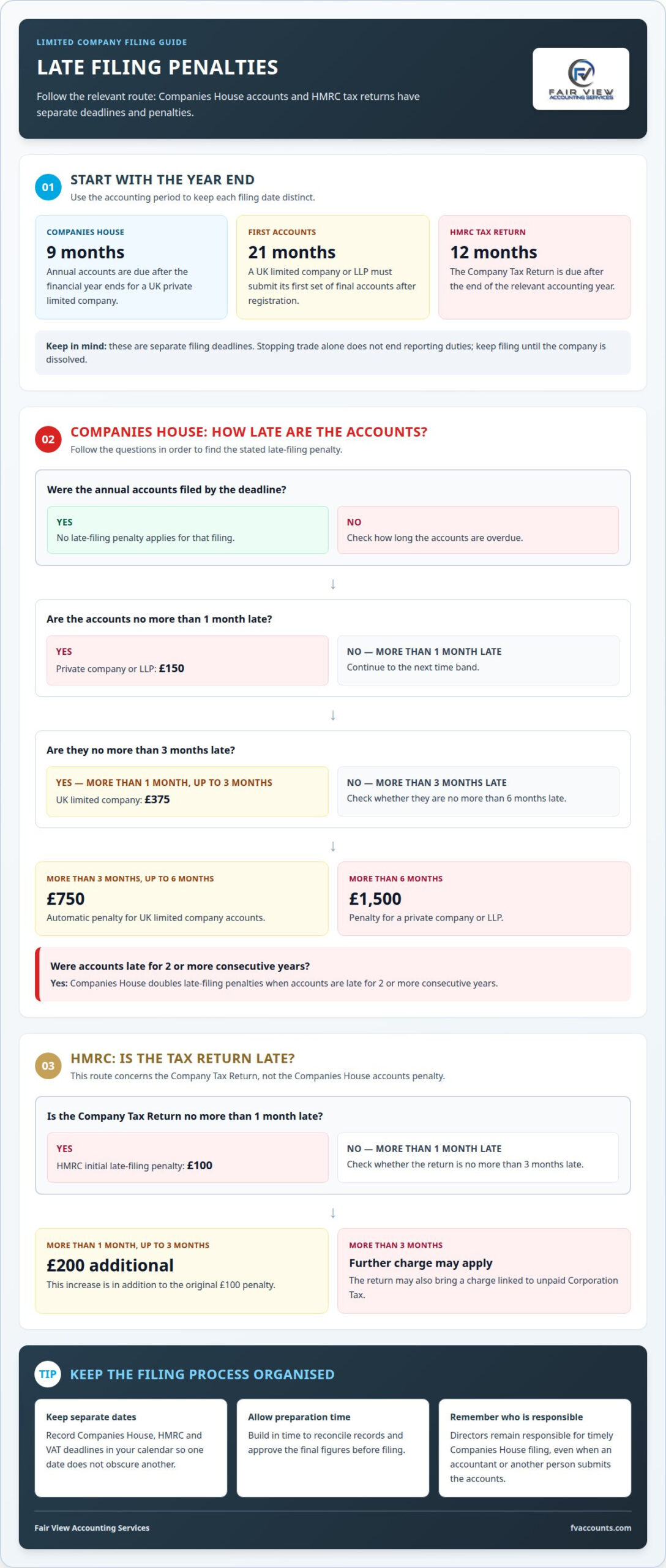
Identify the company’s accounting reference date, then use it to plan annual accounts filing. Companies House requires a UK private limited company to file annual accounts within 9 months after its financial year ends. Companies House also requires a UK limited company or LLP to submit its first set of final accounts 21 months after registration.
HM Revenue & Customs requires a UK limited company to submit its Company Tax Return, including final accounts, within 12 months of the end of the relevant accounting year. Dormant companies still file accounts. Micro-entity and small-company accounts may contain less information than full accounts, if the company qualifies.
-
Confirm final filing requirements after trading stops
Keep filing until the company is dissolved; stopping trade alone doesn’t end its reporting duties. A UK private limited company must file its accounts with Companies House within 9 months after its financial year ends, not 1 day after it ends. The final return and accounts cover the company’s last relevant accounting period.
An accountant can prepare the final figures, accounts and Company Tax Return, then submit the return and supporting accounts to HMRC. Before dissolution, account for the company’s assets, debts and outstanding tax obligations. Filing accounts and closing a company are separate processes, so allow time for both.
- For VAT, register if taxable turnover exceeds £90,000 in a 12-month period. VAT Returns are normally due 1 month and 7 days after the VAT accounting period ends. Include VAT dates in the filing calendar as well as Companies House and HMRC dates, so one deadline doesn’t obscure another.
Late filing penalties
- Submit annual accounts by the Companies House deadline, even if the company made no profit. Companies House charges a private company or LLP £150 when accounts are no more than 1 month late. Directors remain responsible for timely filing, even when an accountant or another person submits the accounts.
- Act quickly if the year-end filing date has passed. Companies House sets the automatic penalty at £375 for UK limited company accounts filed more than 1 month but no more than 3 months late. The penalty rises to £750 when accounts are more than 3 months but no more than 6 months late. More than 6 months late, the Companies House penalty for a private company or LLP is £1,500.
- Track consecutive late filings as well as the current accounting period. Companies House doubles late-filing penalties when accounts are late for 2 or more consecutive years. A late submission can therefore cost more than one filed after a previous on-time year. Build preparation time into the accounts process, including time to reconcile records and approve the final figures.
- Keep the company tax return deadline on a separate calendar from the Companies House accounts date. HMRC’s initial late-filing penalty is £100 when a return is no more than 1 month late. It increases by £200 when the return is more than 1 month but no more than 3 months late, in addition to the original penalty. A return more than 3 months late may also bring a charge linked to unpaid Corporation Tax.
If deadlines have slipped, discuss late accounts support before another filing date passes.
Where limited companies file accounts
- Give your accountant the records needed to establish the financial year and accounting reference date. Useful documents include bank statements, sales and purchase records, payroll details, asset information, loan balances and previous accounts. These records help show the company’s financial position and whether it made a profit or loss. When filing final accounts for a limited company that is closing, include details of its trading activity, assets and outstanding debts.
- Ask your accountant to prepare statutory accounts from the company’s records. They organise the figures into statements, including a balance sheet and profit and loss account, and prepare relevant supporting information. Directors must approve the annual accounts before they are filed with Companies House. This process helps ensure the figures reflect the company’s full financial year, not just its latest transactions.
- Confirm which filing destination applies to each document. Companies House receives the company’s annual accounts; HMRC receives the Company Tax Return, including accounts, through the relevant filing route. Most companies can use accounting software or the company accounts and tax online service to submit accounts to Companies House and a CT600 to HMRC together. They can also file separately.
- For a company being closed, have its final accounts and Corporation Tax Return prepared and submitted for the relevant accounting period. Filing final accounts for a limited company during closure involves preparing the final figures from its records, then submitting the accounts to Companies House and the return to HMRC. Provide complete records promptly and agree which filings are needed for the closure process.
Fair View Accounting Services
Fair View Accounting Services helps limited companies organise annual accounts and Corporation Tax reporting around their accounting periods and filing deadlines. Based in Manchester, the firm supports businesses in Bolton with preparing accounts from business records and coordinating related tax reporting.
Clear records of income, expenses, assets and liabilities help ensure accounts reflect the company’s financial position. Fair View Accounting Services can support this work through its Annual Accounts and Corporation Tax services.
Contact Fair View Accounting Services to discuss support with your company accounts.
Set up your next accounts with confidence
Make the next accounting cycle easier by keeping financial records organised throughout the year. A reliable process for filing final accounts for a limited company starts before year end: keep invoices, bank records, payroll information and details of company assets accessible so the accounts can be prepared from clear records.
Fair View Accounting Services supports this work through its Annual Accounts and Corporation Tax services, and provides an Accountant’s Certificate. Coordinating accounting and tax work helps keep related reporting tasks connected. Consider professional support when preparing your next accounts or planning a company’s final return.
A steady routine can make the next step more manageable.
Frequently Asked Questions
What is my company year end?
Your company year end is its accounting reference date, which sets the period covered by its annual accounts. For a new UK company, this date is generally the anniversary of the last day of its incorporation month. For an existing company, it is generally the anniversary of the day after its previous financial year ended. Use the registered date to identify the relevant period.
What happens if I miss any of my year end reporting deadlines?
Missing a deadline can trigger a penalty, and late accounts may become more costly if the company has filed late in consecutive years. HMRC may also impose penalties for a late Company Tax Return, separate from Companies House penalties. Submit overdue documents promptly and pay any tax due. Keep evidence of submission and payment with the company’s records.
What is year-end accounting?
Year-end accounting means organising a company’s records for its financial year and using them to prepare accounts. It brings together transactions such as sales, purchases, payroll, bank activity, assets and liabilities. The resulting statements show the company’s financial position and trading result. Keeping clear records throughout the year makes it easier to explain unusual entries and prepare accurate accounts.
Do all companies have to submit a confirmation statement and accounts?
UK limited companies must file accounts with Companies House, and they must submit a confirmation statement even if dormant. A confirmation statement is due at least once every 12 months, with filing due within 14 days of its due date. These filings are separate: the statement confirms company information, while accounts report financial activity and position.
Do dormant companies need to file?
Yes. A dormant company must still file annual accounts with Companies House and submit a confirmation statement. Companies House considers a company dormant when it has had no significant transactions during the financial year being reported. Filing fees, late-filing penalties and money paid for shares when the company was incorporated are excluded from significant transactions for this purpose.
Disclaimer
The information provided in this article is for general guidance only and is not intended to constitute professional advice, tax advice, financial advice, legal advice, or any other form of regulated guidance. Although every effort has been made to ensure accuracy at the time of publication, Fair View Accounting Services, including its director, employees, contractors, writers, and content-creation team, accepts no responsibility for any loss, damage, penalty, or consequence arising from reliance on the information contained herein.
UK tax legislation changes frequently, and HMRC interpretations, thresholds, and rules may vary depending on the individual circumstances of each taxpayer. Nothing in this article should be considered a substitute for obtaining formal, personalised advice from a qualified accountant or tax professional. Readers should not take action or refrain from taking action based solely on the content published on this website.
Fair View Accounting Services does not guarantee the completeness, accuracy, or ongoing validity of the information provided and assumes no liability for omissions or errors, whether typographical, factual, or technical. By using this content, the reader acknowledges that all responsibility for decisions remains solely with the user.