

Moving from sole trader to limited company is more than changing the name on an invoice. A limited company is legally separate from its owners, whose responsibility for business debts is generally limited to the value of their investment.
It’s understandable to want a clear picture before making the change: incorporation affects how your business is owned, registered and taxed. This guide to setting up a limited company in the UK explains the essentials, including the director and shareholder roles, choosing a suitable company name and registering with Companies House.
This guide also covers practical steps for moving from sole trader status, from planning the changeover to understanding the company’s ongoing filing and tax responsibilities. Tip: Use it to assess whether incorporating suits your business and plan your next steps with confidence.
Key Takeaways
- Tip: Understand how a limited company’s separate legal identity changes the way ownership and business debts work.
- Tip: Consider what makes a company name suitable before preparing your registration application.
- Tip: Plan the move from sole trader status by mapping out the changes your business will need to make.
- Tip: Get a clear view of the company’s ongoing accounts and Corporation Tax responsibilities after incorporation.
What is a limited company?
A UK limited company is legally separate from its owners. That separation generally limits owners’ responsibility for business debts to their investment. After formation, UK limited companies must comply with laws including the Companies Act 2006, according to UK legislation. This setting up a limited company UK guide also explains the practical decisions that follow registration.
- Confirm who will run and own the company. A private limited company needs at least one director, aged 16 or older, and at least one shareholder. One person can hold both roles. Anyone owning more than 25% of shares or voting rights is treated as having significant control.
- Prepare the registration details and documents. Provide the company name, registered office address, contact email, SIC code describing its activity, and details for directors and shareholders. Include share information and personal information for applicants. Companies House records people with significant control. From autumn 2025, directors and people with significant control must complete identity verification checks.
- Submit the incorporation application. Companies House allows online registration. Once approved, incorporation creates the separate legal entity and its filing responsibilities.
- Set up tax records and meet filing duties. Companies formed online are automatically registered for Corporation Tax; other companies must register with HMRC within 3 months of starting to trade. VAT registration is free, and the threshold is £90,000 of taxable turnover per year, according to HM Revenue & Customs. This setting up a limited company UK guide highlights why tax registration and records matter.
HM Revenue & Customs says a UK company’s Corporation Tax return must normally be filed within 12 months of the end of its Corporation Tax accounting period. Directors remain responsible for accurate records, even when they receive accounting support. Missing filings or mixing personal and company finances can create compliance problems, so organise records from the outset.
Choosing a company name
Directors are responsible for company records, accounts and performance, even when they receive support. Shareholders own shares. A shareholder who also becomes a director takes on director responsibilities too.
- Choose a name that fits the business. Write down a shortlist that is clear to say, spell and remember. Consider whether it will still suit the company if its products, customers or activities change. A distinctive name can also help customers tell the business apart from others.
- Separate the registered name from the trading identity. Decide whether the name entered during incorporation should also appear on your public-facing brand. If you plan to trade under a different name, consider how customers will recognise the connection across invoices, correspondence and other business materials.
- Select a company type before finalising the name. A company limited by shares has shareholders; a company limited by guarantee has guarantors, with at least one required. Choose the structure that reflects how the organisation will be owned and governed, rather than treating the name as the main decision.
- Compare formation package details. A package may cover different parts of the incorporation process, so read its scope before choosing. Check how it handles submitting the selected company name and preparing registration documents. The package does not replace directors’ legal responsibilities after formation.
- Review the full name in context. Check that it reads clearly on an invoice, website heading and email address. A short, easy-to-spell name can reduce confusion during trading. Keep the chosen name consistent in your records and communications.
A company name does not determine its Corporation Tax responsibilities. For help with the tax side of incorporation, discuss Corporation Tax support.
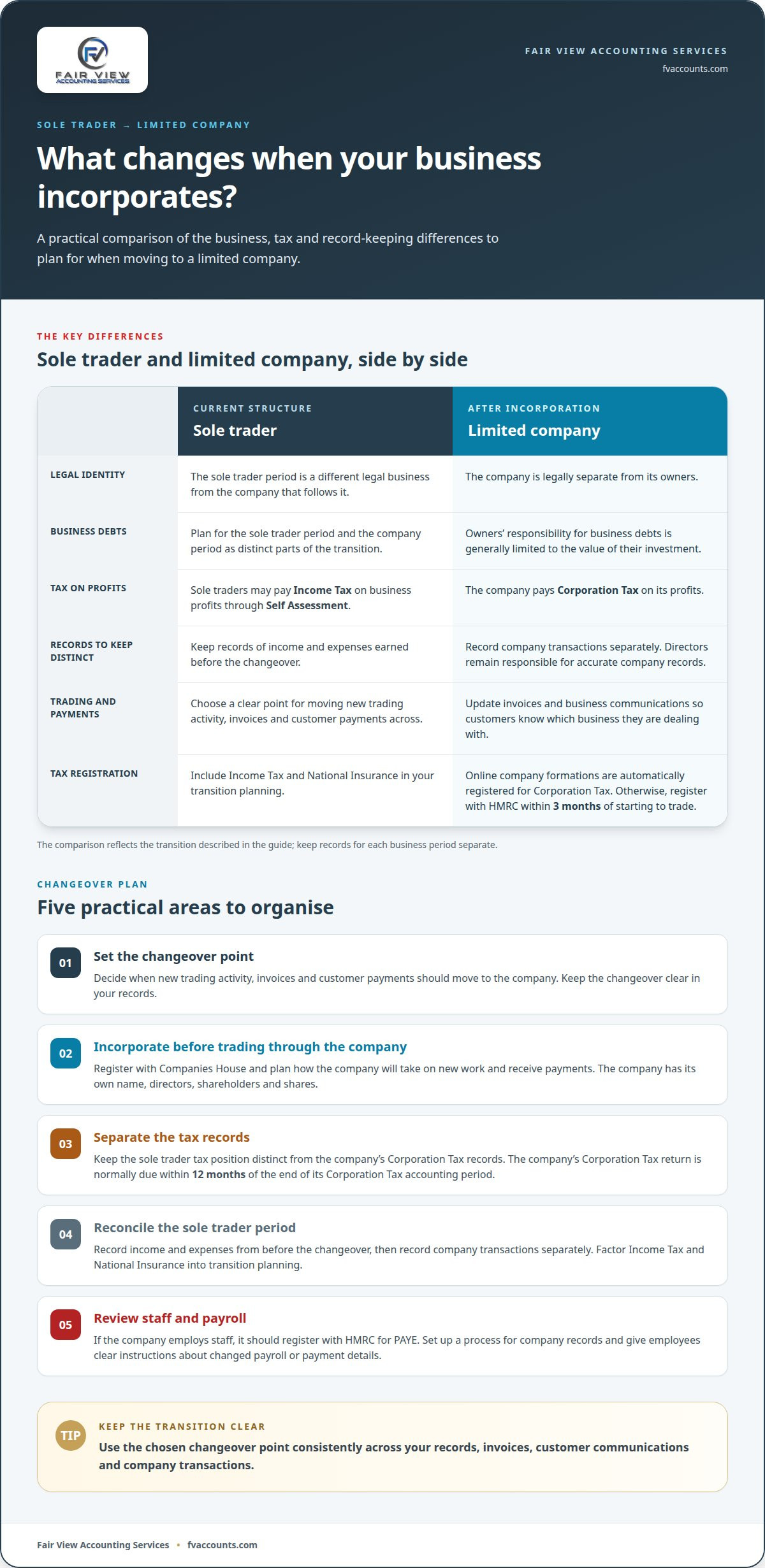
Transitioning from sole trader to limited company
- Choose a practical changeover point. A sole trader and a private limited company are different legal businesses. The company is legally separate from you, so decide when new trading activity, invoices and customer payments should move across. Keep the changeover clear in your records.
- Register the company before it starts trading. Use Companies House to incorporate the private company, with its own name, directors, shareholders and shares. Plan how the company will accept new work and payments. Update invoices and business communications so customers know which business they are dealing with.
- Separate the tax records. Sole traders do not pay Corporation Tax; they may pay Income Tax on business profits through Self Assessment. A limited company pays Corporation Tax on its profits. If it was not formed through the Companies House online service, register for Corporation Tax within 3 months of starting to trade.
- Reconcile the sole trader period. Keep records of income and expenses earned before the changeover, then record company transactions separately. This helps distinguish the old business’s tax position from the company’s accounts. Include Income Tax and National Insurance in your transition planning.
- Review employees and ongoing obligations. If the company employs staff, it should register with HMRC for PAYE. Set up a record-keeping process for company transactions, and make sure employees receive clear instructions about any changed payroll or payment details.
Fair View Accounting Services
Fair View Accounting Services supports businesses moving into limited company status and managing their reporting responsibilities. Its services include Annual Accounts and Corporation Tax, helping you organise company records and handle ongoing financial obligations.
Consider accounting support when planning the change from sole trader, setting up company accounting processes or preparing for the first reporting period. Directors remain responsible for records and filings, so clear, consistent bookkeeping helps you stay informed and meet your duties.
For a practical next step, gather your planned incorporation date and a summary of how your business currently operates. This gives you a useful starting point for discussing the accounting and tax work involved.
Turn your incorporation plans into action
A guide to setting up a limited company in the UK is most useful when it helps you make a considered decision. Before proceeding, set out what you want the company structure to achieve and how you’ll manage its responsibilities alongside day-to-day work. A clear plan helps you approach incorporation deliberately, rather than treating it as paperwork alone.
Fair View Accounting Services provides Accountant’s Certificate, Annual Accounts and Corporation Tax services. These can address specific accounting and tax needs as your company gets established and continues trading. Choose support that fits the work you need, while remembering that directors remain responsible for their company’s obligations.
Take the next step with a clear understanding of your plans and the support that will help you put them into practice.
Frequently Asked Questions
Is going limited the right choice?
Going limited may suit a business seeking a separate legal structure or expecting its ownership and operations to grow. Tip: Weigh the administrative responsibilities against the benefits for your circumstances. For example, consider whether you’re ready to keep company records and manage filings alongside your usual work. If your business remains straightforward, compare the practical demands of each structure before deciding.
What about ongoing running costs?
Plan for ongoing administration, not only incorporation. A company must maintain records, prepare accounts, file tax returns and submit a Confirmation Statement annually. Employing staff can add payroll administration. Costs depend on the company’s activity, transaction volume and whether it has employees. Separate essential compliance work from optional support when setting your budget.
What’s in this guide?
This guide takes you from considering incorporation to organising the new company. It explains what a limited company means for ownership, how to choose a suitable name and how to plan a change from sole trader trading. Use it to identify decisions to address before registration, then plan the record-keeping and reporting arrangements your business will need.
How do you register a limited company with Companies House step by step?
First, decide on the company structure and prepare its name, registered office, SIC code, director and shareholder details, and share information. Include the contact and identity details required for the application. Apply online or by post to Companies House. After approval, retain the incorporation documents and organise the company’s accounting records. Then handle tax registration according to how the company was formed and when it begins trading.
How do you choose a company name and check whether it is available in the UK?
Start with a shortlist of names that are easy to spell and distinguish from your trading brand. Search the Companies House register for each proposed name, including likely spelling variations, to find existing entries. Treat this as a preliminary check, then submit your chosen name with the incorporation application. Keep a backup option in case Companies House does not accept your first choice.
Disclaimer
The information provided in this article is for general guidance only and is not intended to constitute professional advice, tax advice, financial advice, legal advice, or any other form of regulated guidance. Although every effort has been made to ensure accuracy at the time of publication, Fair View Accounting Services, including its director, employees, contractors, writers, and content-creation team, accepts no responsibility for any loss, damage, penalty, or consequence arising from reliance on the information contained herein.
UK tax legislation changes frequently, and HMRC interpretations, thresholds, and rules may vary depending on the individual circumstances of each taxpayer. Nothing in this article should be considered a substitute for obtaining formal, personalised advice from a qualified accountant or tax professional. Readers should not take action or refrain from taking action based solely on the content published on this website.
Fair View Accounting Services does not guarantee the completeness, accuracy, or ongoing validity of the information provided and assumes no liability for omissions or errors, whether typographical, factual, or technical. By using this content, the reader acknowledges that all responsibility for decisions remains solely with the user.