

The lowest payroll fee is not always the lowest-cost option once you account for your time and any extra processing charges. Small business payroll costs in the UK depend on whether you outsource payroll or manage it in-house with software, as well as your team size, pay frequency and payroll complexity.
It is understandable to focus on the monthly bill, but the full budget matters too. Outsourcing can reduce the administration you handle yourself, while software lets you process payroll in-house.
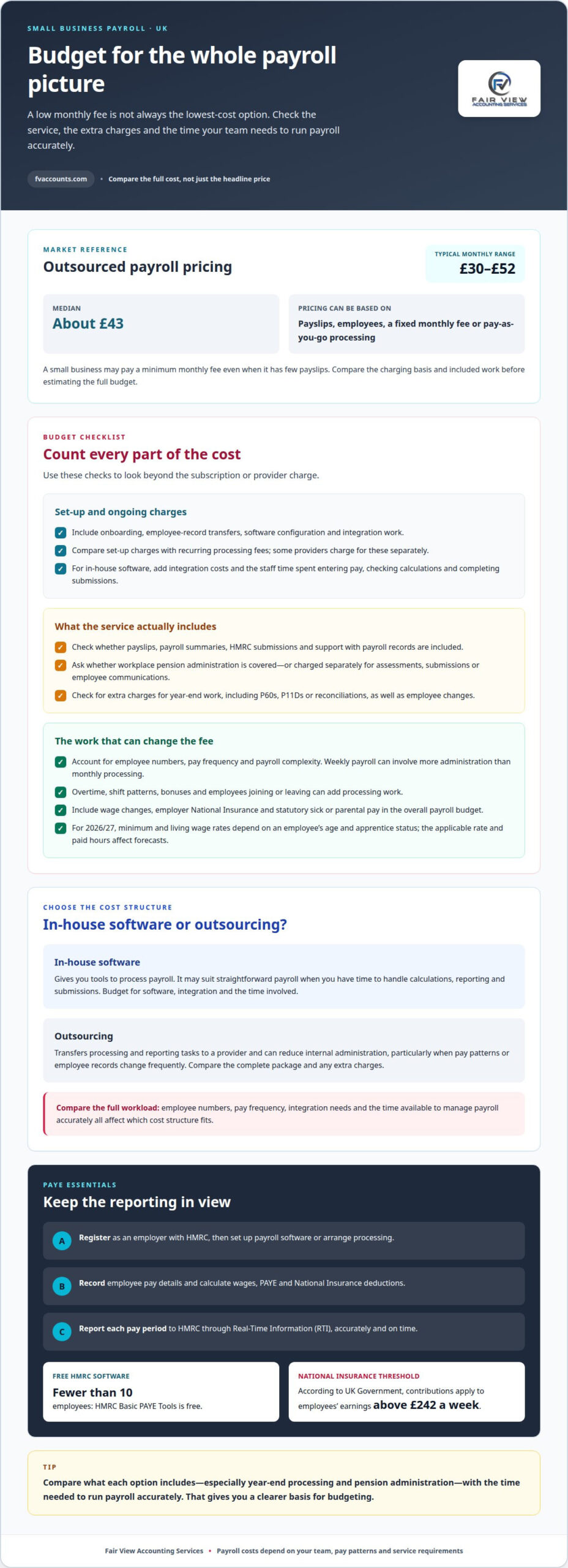
This guide explains what affects the cost of each option and how to weigh them against your business’s needs. Tip: compare what each option includes, such as year-end processing and pension administration, with the time required to run payroll accurately. This gives you a clearer basis for budgeting and choosing an approach that fits your business.
Key Takeaways
- Include payroll setup and onboarding charges in your budget, not just the ongoing service fee.
- Compare outsourced payroll pricing by payslip and by employee, and account for pay frequency and payroll complexity.
- Weigh software costs against the time needed to run payroll in-house and manage reporting accurately.
- Tip: review what each option includes, particularly year-end processing and pension administration, before deciding what suits your business.
How much is payroll for small businesses?
Payroll setup can involve onboarding the business, transferring employee records and configuring software. Some providers charge separately for these steps, so include setup and integration work in your budget alongside the ongoing fee. Compare the setup and recurring processing included, not just the headline fee.
Outsourced payroll fees depend on employee numbers, pay frequency and complexity. An accountant’s charge may also reflect pension enrolment, year-end reporting and support with payroll records. Weekly pay, overtime, shift patterns, bonuses, and employees joining or leaving can all add processing work. Ask what the service includes, such as payslips, payroll summaries, HMRC submissions and pension administration.
Some providers include workplace pension administration in their fee; others charge separately for assessments, submissions or employee communications. Year-end work can also be an extra, including P60s, P11Ds or reconciliations. These differences affect the total cost, even where two services appear to have similar monthly fees.
Hiring an employee means running payroll to calculate wages and PAYE and National Insurance deductions. A contractor generally invoices for work rather than receiving employee payroll. Construction businesses may also need to account for CIS processing.
For each pay period, employers must report payroll accurately and on time to HMRC through Real-Time Information (RTI). Late or incorrect filing can have consequences, so employers should take care to report payroll accurately and on time.
To start PAYE payroll, register as an employer with HMRC, set up payroll software or arrange processing, record employee pay details, then report each pay period through RTI. HMRC Basic PAYE Tools is free for businesses with fewer than ten employees. According to UK Government, National Insurance contributions apply to employees’ earnings above £242 a week.
How Much Does It Cost to Outsource Payroll in the UK?
Outsourced payroll charges may be based on payslips, employees or a fixed monthly fee. Employer costs also vary with wages, National Insurance and statutory pay.
Outsourced payroll pricing
A small business may instead pay a fixed minimum monthly fee, even with few payslips. Managed payroll packages can bundle processing and submissions, while pay-as-you-go pricing links the charge to payroll volume. Compare the charging basis and included work before setting your budget.
Employer contributions and wage changes
Employer National Insurance is a payroll cost on top of employee wages, and wage changes can increase the amount a business pays. Both affect the total payroll budget, even when the provider’s monthly charge stays the same. A pay rise can also change the figures used in payroll processing and submissions. Include wage changes and employer contributions in forecasts, rather than treating the provider fee as the full payroll cost.
Minimum and living wage costs
The National Minimum Wage and National Living Wage are statutory hourly pay floors. For 2026/27, the applicable rate depends on the employee’s age and apprentice status. These rates affect the wage bill and the payroll figures used for accurate payslips. Build forecasts around each worker’s applicable rate and paid hours; a change to hourly pay can affect total employer costs as well as payroll calculations.
Statutory pay costs
Statutory sick pay and parental pay can change the amounts processed through payroll during an absence. Their impact on the payroll cost depends on the pay due and the employee’s circumstances. Keep these payments in your payroll records so payslips and submissions reflect the amounts processed. If changing pay patterns or staff absences complicate budgeting, discuss your payroll requirements.
Outsourcing versus in-house software costs
In-house software and payroll outsourcing have different cost structures. Software gives you tools to process payroll; outsourcing transfers processing and reporting tasks to a provider. The better fit depends on staff numbers, pay frequency, integration needs and the time available to manage payroll accurately. These factors shape small business payroll costs in the UK beyond the software subscription or provider charge.
Those subscriptions do not include staff time spent entering pay, checking calculations and completing submissions. Include that time when budgeting for small business payroll costs in the UK.
Payroll outsourcing on the market typically costs £30 to £52 per month, with a median of about £43. Pricing models include fixed packages, per-employee charges and pay-as-you-go processing. Weekly payroll can require more administrative work than monthly processing. Providers may charge extra for setup, employee changes, year-end reporting or pension administration, so compare inclusions alongside the headline fee.
Integration is another budget factor. In-house software can suit a business with straightforward payroll and time to handle reporting. Outsourcing can reduce internal processing demands, particularly when pay patterns or employee records change frequently. Compare annual software and integration costs with the full outsourcing package, then include the time required for each approach.
For a start-up, consider pay frequency, reporting workload and available administrative time before choosing how to manage small business payroll costs in the UK.
Fair View Accounting Services: Payroll
Fair View Accounting Services provides payroll support for small businesses that want help managing employee pay and payroll administration. This can be useful when payroll takes time away from running the business or changing pay patterns make in-house administration harder to manage.
For a start-up, payroll needs can change as the team grows. The right support depends on factors such as employee numbers, pay frequency and payroll complexity. Discussing these requirements can clarify which tasks need support and how payroll fits alongside your business’s other accounting needs.
Before discussing the next step, outline your current payroll process, pay schedule and any recent changes. This gives the conversation a practical focus without assuming that one approach suits every business.
Contact Fair View Accounting Services to discuss your payroll requirements.
Make payroll planning your next step
Planning for small business payroll costs in the UK is also an opportunity to fit payroll into your wider business routines. Consider who will manage payroll information, how you will keep records organised and when you will review your approach as the business changes. A clear process helps you plan responsibilities alongside everyday financial administration.
Fair View Accounting Services also provides Annual Accounts, Corporation Tax and an Accountant’s Certificate, supporting businesses with related accounting needs. Considering these requirements together can help you plan your next steps with a broader view of your financial workload.
Choose an approach that works for your current operations, then review it as your team or processes change. A considered plan can make payroll easier to manage as your business develops.
With a clear process in place, you can focus more confidently on running and growing your business.
Frequently Asked Questions
Are There Free Payroll Solutions Available?
Yes. HMRC Basic PAYE Tools is free for eligible small employers. The software can support payroll processing, but it does not remove the time needed to enter pay details, produce records and submit payroll information. Consider whether someone in the business can handle these tasks consistently, especially when pay or employee details change.
Is payroll a legal requirement?
Employers must meet payroll reporting and payment obligations, but outsourcing payroll is not mandatory. A business can process payroll in-house or use a provider. The important distinction is that delegating the work doesn’t remove the employer’s responsibility for accurate, timely reporting. A contractor arrangement may have different payroll treatment from employing staff, depending on the working relationship.
What Is the Cheapest Way to Manage Payroll?
For an eligible employer with straightforward payroll, managing it in-house with HMRC Basic PAYE Tools can avoid a paid software subscription or outsourced service fee. It still takes time to maintain accurate employee records and complete each payroll task. Assess the workload as well as direct spending before deciding whether a no-subscription option is economical for your business.
What are the costs of keeping payroll in-house?
In-house payroll costs include the software subscription, staff time and any work needed to resolve processing errors. For example, a business with variable hours may need more time to gather and check pay information than one with consistent salaries. Consider who will handle reporting during busy periods or staff absence, since internal capacity affects the practical cost.
What is the average cost of payroll services for a small business in the UK?
As a broad market guide, the typical monthly price for a small-business payroll service is £30 to £52, with a median of about £43. Treat this as a market reference, not a quote for your business. The actual charge depends on factors such as employee numbers, pay frequency, processing complexity and which services the package includes.
Disclaimer
The information provided in this article is for general guidance only and is not intended to constitute professional advice, tax advice, financial advice, legal advice, or any other form of regulated guidance. Although every effort has been made to ensure accuracy at the time of publication, Fair View Accounting Services, including its director, employees, contractors, writers, and content-creation team, accepts no responsibility for any loss, damage, penalty, or consequence arising from reliance on the information contained herein.
UK tax legislation changes frequently, and HMRC interpretations, thresholds, and rules may vary depending on the individual circumstances of each taxpayer. Nothing in this article should be considered a substitute for obtaining formal, personalised advice from a qualified accountant or tax professional. Readers should not take action or refrain from taking action based solely on the content published on this website.
Fair View Accounting Services does not guarantee the completeness, accuracy, or ongoing validity of the information provided and assumes no liability for omissions or errors, whether typographical, factual, or technical. By using this content, the reader acknowledges that all responsibility for decisions remains solely with the user.