

Have you used Business Asset Disposal Relief before? You may still be able to claim it: there’s no limit on the number of claims, but the lifetime relief limit is £1 million, according to HM Revenue & Customs. For qualifying gains, the relief rate is 18% from 6 April 2026.
Tax on selling a business in the UK depends on what you sell, how the sale is structured and whether you qualify for relief. Selling a sole trader business or a partnership interest involves different tax considerations from selling company shares. This guide covers the main Capital Gains Tax rules, Business Asset Disposal Relief and practical steps to take before a sale. Tip: check whether you qualify for relief before selling.
Key Takeaways
- Identify which Business Asset Disposal Relief conditions apply to your shareholding before relying on the relief.
- Separate the sale proceeds from the taxable gain, and consider how allowable costs and reliefs affect the calculation.
- Compare the tax implications of selling company shares with selling business assets, including how sale proceeds are extracted.
- For a sole trader or partnership sale, distinguish capital assets from trading stock, as they may be taxed differently.
Business Asset Disposal Relief eligibility and rate
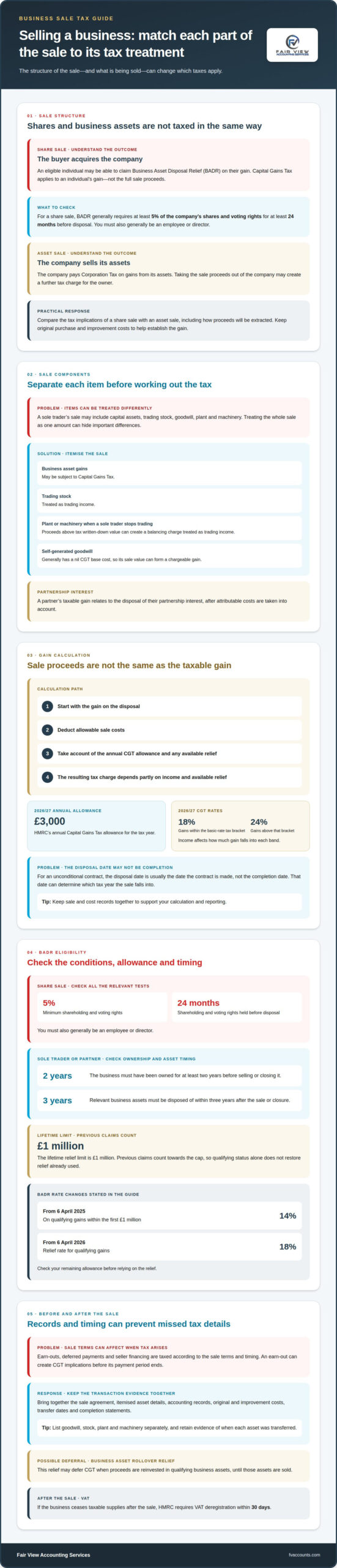
Business Asset Disposal Relief (BADR) may reduce Capital Gains Tax on qualifying disposals, but eligibility depends on what you sell and your role. For a share sale, HM Revenue & Customs requires at least 5% of the company’s shares and voting rights for at least 24 months before disposal. You must also generally be an employee or director.
HM Revenue & Customs states that BADR rises to 14% on qualifying gains within the first £1 million from 6 April 2025. Its lifetime relief limit is £1 million, so previous claims count towards that cap. Check your remaining allowance before relying on the relief; qualifying status alone does not restore used relief.
The sale structure determines which tax rules apply. In a share sale, the buyer acquires the company, and an eligible individual may be able to claim BADR on the gain. In an asset sale, the company pays Corporation Tax on gains from its assets, and taking the proceeds out of the company may create a further tax charge for the owner. Keep records of original purchase and improvement costs, as these help establish the gain.
Business Asset Rollover Relief may defer CGT when proceeds are reinvested in qualifying business assets, until those assets are sold. Earn-outs, deferred payments and seller financing are taxed according to the sale terms and timing; an earn-out can create CGT implications before its payment period ends. If the business ceases taxable supplies after the sale, HM Revenue & Customs requires VAT deregistration within 30 days.
Capital gains tax when selling shares or a business
Capital Gains Tax applies to an individual’s gain, not the full sale proceeds. HM Revenue & Customs sets the annual Capital Gains Tax allowance at £3,000 for the 2026/27 tax year. Deduct allowable sale costs and the allowance when calculating the taxable gain. The resulting charge depends partly on income and available tax relief.
For the 2026/27 tax year, HM Revenue & Customs taxes gains within the basic-rate tax bracket at 18%, and gains above that bracket at 24%. Income affects how much gain falls into each band. The tax on selling a business in the UK also depends on whether you sell shares or dispose of business assets, and whether you qualify for relief.
A limited company pays Corporation Tax on profits from selling its assets, while an individual may owe Capital Gains Tax on a disposal. If part of a home is used exclusively for business, that part may be subject to CGT when the property is sold. For a sole trader who stops trading, proceeds from plant or machinery above its tax written-down value can create a balancing charge treated as trading income.
For tax on selling a business in the UK, the disposal date can determine which tax year the sale falls into. Under an unconditional contract, this is usually the date the contract is made, not the completion date. Keep sale and cost records together to support your calculation and reporting. The main taxes to consider are CGT for individual sellers and Corporation Tax on company asset disposals.
Selling a sole trader business or partnership interest
For a sole trader, tax on selling a business in the UK depends on which assets are transferred and how each part of the sale is classified. Gains on business assets may be subject to Capital Gains Tax, while trading stock sold with the business is treated as trading income. A partner’s taxable gain relates to the disposal of their partnership interest, after attributable costs are taken into account.
Business Asset Disposal Relief eligibility has conditions beyond the sale itself. A sole trader or partner must have owned the business for at least two years before selling or closing it. The relevant business assets must be disposed of within 3 years after the sale or closure. Keep records that show ownership and when each asset was transferred. Tip: Keep sale records itemised and retain evidence of transfer dates.
Self-generated goodwill generally has a nil CGT base cost, so its sale value can form a chargeable gain. In a sole-trader consultancy example, CGT is £43,560 after BADR and the Annual Exempt Amount are applied from 6 April 2026. The seller’s actual gain and relief eligibility affect the calculation.
List goodwill, stock, plant and machinery separately in the sale records. Their tax treatment can differ, especially when a sole trader stops trading. For tax on selling a business in the UK, separating trading profits from capital gains helps show which amounts are income and which relate to asset disposals. A company’s tax treatment differs because it is a separate legal entity.
Fair View Accounting Services: Accountants for start-up businesses
Fair View Accounting Services can help owners prepare to sell, close or reorganise a business. Its accountants support start-ups as their record-keeping and reporting needs develop. Before a sale, clear financial records help show the business’s position and support accurate reporting after completion.
Annual Accounts provide a consistent record of a business’s performance and financial position. Corporation Tax support helps with the company’s tax reporting on profits, including profits from asset sales. The appropriate accounting treatment depends on the business structure and transaction, so keep company records separate from personal sale documents.
Practical tip: bring together the sale agreement, asset details, accounting records and completion statements. Reviewing them together helps connect the agreed transaction with the figures in the accounts. If a lender or another party requires an Accountant’s Certificate, Fair View Accounting Services provides this service.
When a business grows from start-up to sale, organised records can make discussions about the transaction clearer. Fair View Accounting Services can help with Annual Accounts and Corporation Tax as the business’s position changes. This support does not replace legal advice on the sale agreement or determine your personal Capital Gains Tax bill.
To discuss your accounting needs, contact Fair View Accounting Services.
Frequently Asked Questions
Can I still claim if I have used BADR before?
Yes, a previous claim does not automatically prevent another claim. HM Revenue & Customs sets the lifetime relief limit at £1 million, and earlier qualifying gains count towards it. The number of claims is not capped, but you must meet the eligibility conditions for each disposal and have some of the lifetime limit remaining. Keep records of earlier claims to establish your remaining allowance.
How much tax will I pay when I sell my business?
The amount depends on whether you sell personally owned assets or company assets, the gain and any relief available. For an individual, income affects whether CGT is charged at 18% or 24% in 2026/27. A company’s asset-sale profits may instead be subject to Corporation Tax. For example, selling company shares and selling the company’s equipment are different transactions, so their tax treatment can differ.
Did the Budget cut the BADR rate?
No, the stated BADR rate increased rather than fell: HM Revenue & Customs gives a rate of 14% from 6 April 2025, rising to 18% from 6 April 2026. A separate change affects the qualifying first band: it falls to £500,000 from 6 April 2027. So distinguish the rate from the amount of gain that can qualify for it.
Do I pay CGT on the full sale price of my business?
No. CGT is generally calculated on the chargeable gain, not the full sale proceeds. The calculation starts with the sale amount, then deducts the asset’s acquisition cost and allowable disposal costs. For example, if you sell shares for more than you paid for them, the entire sale price is not treated as a gain.
Do I pay taxes if I reinvest the sale proceeds?
Reinvesting sale proceeds does not automatically remove tax. Business Asset Rollover Relief may defer CGT when proceeds are reinvested in qualifying business assets, with the deferred gain becoming relevant when those replacement assets are sold. The relief applies to qualifying assets, so putting proceeds into another investment does not by itself establish eligibility. The asset type and its use in the trade matter.
Disclaimer
The information provided in this article is for general guidance only and is not intended to constitute professional advice, tax advice, financial advice, legal advice, or any other form of regulated guidance. Although every effort has been made to ensure accuracy at the time of publication, Fair View Accounting Services, including its director, employees, contractors, writers, and content-creation team, accepts no responsibility for any loss, damage, penalty, or consequence arising from reliance on the information contained herein.
UK tax legislation changes frequently, and HMRC interpretations, thresholds, and rules may vary depending on the individual circumstances of each taxpayer. Nothing in this article should be considered a substitute for obtaining formal, personalised advice from a qualified accountant or tax professional. Readers should not take action or refrain from taking action based solely on the content published on this website.
Fair View Accounting Services does not guarantee the completeness, accuracy, or ongoing validity of the information provided and assumes no liability for omissions or errors, whether typographical, factual, or technical. By using this content, the reader acknowledges that all responsibility for decisions remains solely with the user.