

What does automatic enrolment mean for a small employer? Eligible workers aged 22 to State Pension age who earn over £10,000 a year must be automatically enrolled in a workplace pension. According to The Pensions Regulator, the minimum employer contribution is 3% of qualifying earnings.
It’s understandable to want clear rules when staff hours and earnings vary between pay periods. Workplace pension contributions are calculated using qualifying earnings, so changes in pay can affect the amounts paid into the pension.
This guide explains who must be enrolled, how contributions work when pay fluctuates and what to consider when choosing a scheme. It also covers practical steps for managing an auto enrolment pension for a small business, including payroll compatibility, scheme costs and how contribution arrangements affect staff. Tips: check payroll compatibility and scheme costs when choosing a scheme.
Key Takeaways
- Work out whether your business has workplace pension duties by considering its staffing and employment arrangements.
- Understand how changing pay can affect pension contributions from one pay period to another.
- Compare scheme costs, payroll compatibility and how the contribution method affects staff.
- See how accounting support can help start-ups manage the financial responsibilities that come with employing staff.
Pension auto enrolment: does it apply to sole traders and limited companies?
Automatic enrolment depends on whether you employ staff, not simply on your business structure. Employers must assess workers’ ages and earnings to determine who is eligible.
Employers required to provide a workplace pension
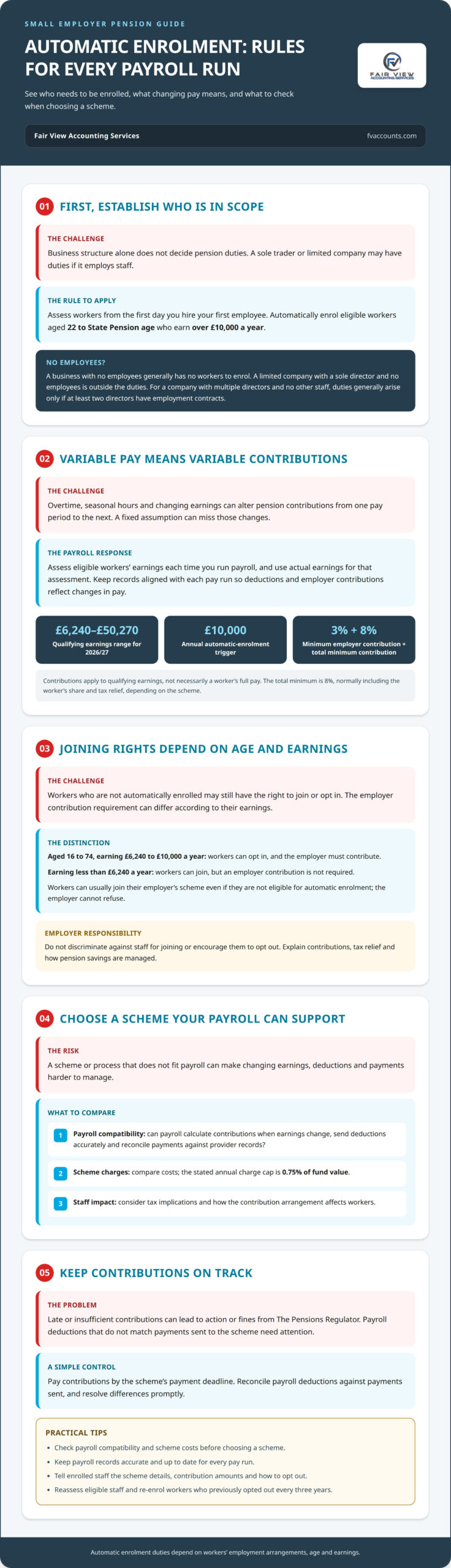
A UK employer with staff must assess workers for automatic enrolment from the first day it hires its first employee. This includes sole traders who employ someone, as well as limited companies. Eligible workers aged 22 to State Pension age earning over £10,000 a year must be enrolled. The Pensions Regulator sets the minimum employer contribution at 3% of qualifying earnings; the total minimum is 8%, normally including the worker’s share and tax relief, depending on the scheme. These national rules mean small employers need a pension scheme and payroll process that can handle contributions.
When automatic enrolment is not required
A business with no employees generally has no workers to enrol. A limited company with a sole director and no employees is outside the duties; for a company with multiple directors and no other staff, duties generally arise only if at least two directors have employment contracts. Workers outside the automatic-enrolment criteria may still opt in. If they earn between £6,240 and £10,000 a year and are aged 16 to 74, the employer must contribute when they opt in.
The Pensions Regulator says an employer can delay a worker’s enrolment date by up to 3 months. Explain the delay in writing, and allow the worker to join sooner if they ask. Workers can opt out after enrolment; employers must not pressure them to leave. Tell enrolled staff the scheme details, contribution amounts and how to opt out.
Employers must also reassess eligible staff and re-enrol workers who previously opted out every three years, according to The Pensions Regulator. Late or insufficient pension contributions can lead to fines, so accurate payroll records are essential.
Pension contributions for workers with variable income
Variable pay can change workplace pension contributions from one payroll run to the next. For an auto enrolment pension for a small business, assess eligible workers’ earnings each time you run payroll.
Earnings thresholds for enrolment and contributions
For 2026/27, qualifying earnings run from £6,240 to £50,270 a year. Contributions apply to qualifying earnings, not necessarily a worker’s full pay. The automatic-enrolment trigger remains £10,000 a year. A worker’s pay may cross that trigger in one period and fall below it in another, so use actual earnings for each assessment rather than assuming a fixed contribution.
Overtime and seasonal hours can affect pension deductions. Keep payroll records aligned with each pay run so employer contributions and workers’ deductions reflect changes in pay. Managing an auto enrolment pension for a small business effectively depends on accurate, up-to-date payroll information.
Paying pension contributions on time
Employers must pay contributions into the workplace pension scheme by its payment deadline. Late or insufficient payments can lead to action or fines from The Pensions Regulator. Reconcile payroll deductions against payments sent to the scheme and resolve any differences promptly. This helps ensure members’ contributions reach their pension accounts and keeps retirement saving records accurate.
Certification may allow a defined contribution scheme to use pensionable pay instead of qualifying earnings. One criterion requires a total contribution of 8%, including at least 3% from the employer, where pensionable pay covers at least 85% of the total pay bill.
Bulk transfers into and out of NEST were permitted from April 2017. These are historical changes, not current contribution thresholds.
Accurate payroll processing can help keep variable-pay calculations consistent. For payroll support with pension deductions, get in touch.
How do you choose a workplace pension scheme?
The employer is responsible for selecting a scheme that meets automatic-enrolment requirements. Workers aged 22 to State Pension age earning over £10,000 a year must be enrolled; other workers can opt in or join, with employer contributions depending on their earnings.
Choosing a scheme for automatic enrolment
Compare scheme charges, payroll compatibility and tax implications for staff before choosing a pension provider. Check that payroll can calculate contributions when earnings change, send deductions accurately and reconcile payments against provider records. A compatible process can reduce manual corrections. An adviser can help with an employer’s scheme choice, while individual investment advice requires appropriate Financial Conduct Authority authorisation.
Scheme requirements and certification
A workplace pension scheme must meet the requirements for automatic enrolment, including a formal agreement for the employer to pay minimum contributions and pass on workers’ contributions. Certification can show that a defined contribution scheme meets contribution standards using pensionable pay. One criterion allows a 7% total contribution, including 3% from the employer, when the total pay bill is pensionable. Scheme charges also matter: the stated annual charge cap is 0.75% of fund value.
Workers’ rights to join a scheme
Workers can usually join their employer’s pension scheme even if they aren’t eligible for automatic enrolment, and the employer cannot refuse. Employers must not discriminate against staff for joining or encourage them to opt out. Explain the scheme clearly so workers understand contributions, tax relief and how their pension savings are managed.
Opting in and joining a pension scheme
Workers aged 16 to 74 earning between £6,240 and £10,000 a year can opt in, and the employer must contribute. Those earning less than £6,240 can join, but an employer contribution isn’t required. In a relief-at-source scheme, a worker’s contribution is typically 4% of qualifying earnings, with tax relief topping it up. Explain the available route clearly and process requests through payroll.
Fair View Accounting Services: Accountants for start up businesses
Fair View Accounting Services supports start-ups with accounting work to help keep business records and reporting organised. If you’re setting up as an employer, this can complement your arrangements for choosing a pension scheme and meeting auto-enrolment duties.
As your business develops, Annual Accounts and Corporation Tax support can help you manage ongoing reporting responsibilities. An Accountant’s Certificate may also be useful when you need formal confirmation of financial information. Clear records make it easier to see how staffing and pension costs affect your business finances.
For support with your start-up’s accounting needs, contact Fair View Accounting Services.
Build a clear plan for your next stage
As your business grows, make pension administration part of your regular financial routines. Keep payroll information, staff changes and contribution records organised so you can respond consistently as your team develops. A considered approach to an auto enrolment pension for a small business can support smoother financial management alongside other reporting responsibilities.
Fair View Accounting Services supports businesses with Annual Accounts, Corporation Tax and Accountant’s Certificates. These services help keep financial reporting in order as your business moves forward. Choose the support that fits your current needs and priorities.
An organised financial foundation can give you greater confidence to focus on what comes next.
Frequently Asked Questions
What is automatic enrolment?
Automatic enrolment is the employer process of assessing staff and placing eligible workers into a workplace pension without requiring an application. For example, a new starter may meet the age and earnings criteria after joining, so assess eligibility through payroll rather than waiting for them to ask. After enrolment, a worker can choose to opt out.
When do new businesses need to register for auto enrolment?
A new business’s duties start on the first day its first employee starts work, so prepare the pension process alongside hiring and payroll setup. The employer must also submit its declaration of compliance within five months of the original duties start date. Keep this reporting deadline separate from the scheme’s enrolment date, particularly if using postponement.
How can I find out what I’ll need to do?
Review staff ages and earnings each time you process payroll, then identify who must be enrolled, can opt in or can join voluntarily. Keep employee details and payroll records together so changes in hours or pay aren’t missed. Fair View Accounting Services provides payroll support to businesses in Manchester, Bolton, Bury, Lancashire and London, helping keep payroll information organised.
What are the pension contribution rates?
The minimum total contribution is 8% of qualifying earnings, including at least 3% from the employer. In a relief-at-source scheme, a worker typically contributes 4% from take-home pay, with tax relief topping up the amount. The cash contribution changes as qualifying earnings change, even when the applicable percentage rates stay the same.
What are your compliance obligations under auto enrolment?
Employers must assess workers, enrol eligible staff, pay contributions and provide written information about the scheme and how to opt out. They must submit a declaration of compliance and keep auto-enrolment records for at least six years. Keep opt-out notices for four years and schedule reminders for re-enrolment duties so these tasks aren’t overlooked.
Disclaimer
The information provided in this article is for general guidance only and is not intended to constitute professional advice, tax advice, financial advice, legal advice, or any other form of regulated guidance. Although every effort has been made to ensure accuracy at the time of publication, Fair View Accounting Services, including its director, employees, contractors, writers, and content-creation team, accepts no responsibility for any loss, damage, penalty, or consequence arising from reliance on the information contained herein.
UK tax legislation changes frequently, and HMRC interpretations, thresholds, and rules may vary depending on the individual circumstances of each taxpayer. Nothing in this article should be considered a substitute for obtaining formal, personalised advice from a qualified accountant or tax professional. Readers should not take action or refrain from taking action based solely on the content published on this website.
Fair View Accounting Services does not guarantee the completeness, accuracy, or ongoing validity of the information provided and assumes no liability for omissions or errors, whether typographical, factual, or technical. By using this content, the reader acknowledges that all responsibility for decisions remains solely with the user.