

A business purchase can reduce the profit on which tax is calculated, but the right capital allowance must apply. Capital allowances for small business owners can provide tax relief on qualifying assets, and the Annual Investment Allowance (AIA) lets businesses deduct qualifying costs up to an annual limit of £1,000,000, according to HM Revenue & Customs. Not every purchase qualifies, so identifying the type of asset matters.
It’s understandable to want a clear answer before investing in equipment or other business assets. This guide explains capital allowances for small business, how they reduce taxable profits and how the Annual Investment Allowance (AIA) works. Tip: keep clear purchase records to help when preparing your accounts. You’ll also find practical tips on which assets may qualify.
Key Takeaways
- Learn how qualifying business assets may reduce taxable profits through capital allowances.
- Understand how the Annual Investment Allowance can provide relief on eligible investment costs.
- See how writing down allowances and asset pools affect relief claimed over time.
- Keep clear records of asset purchases and business use to support accurate accounts and claims.
What is the Annual Investment Allowance and how does it work?
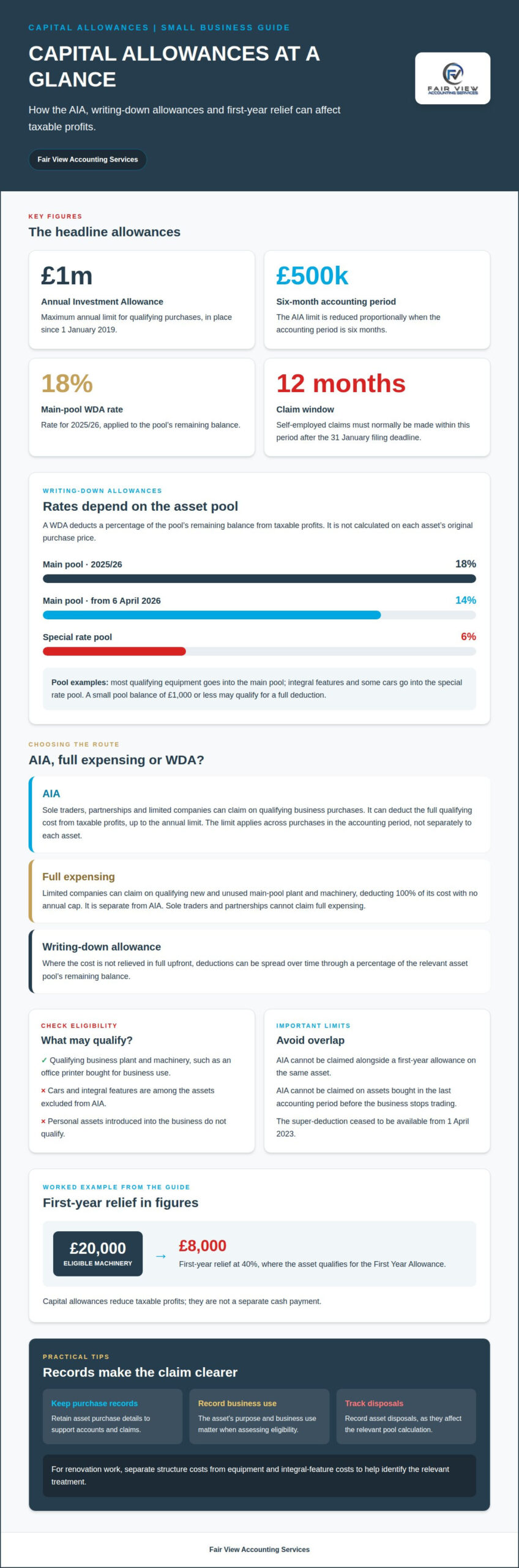
The Annual Investment Allowance (AIA) lets eligible businesses deduct the full cost of qualifying plant and machinery from taxable profits. HM Revenue & Customs states that the maximum has been £1,000,000 per year since 1 January 2019.
Annual Investment Allowance eligibility
Sole traders, partnerships and limited companies can claim the AIA on qualifying business purchases. This lets a business claim capital allowances on eligible equipment without spreading its full cost over several years. For example, a qualifying office printer bought for business use may receive relief through the AIA. Cars and integral features are among the excluded assets. Personal assets introduced into the business do not qualify, so the asset’s purpose and purchase history matter.
Annual Investment Allowance limits
The AIA limit applies across qualifying purchases within an accounting period, rather than separately to each asset. If the accounting period is six months, the limit is reduced proportionally to £500,000. A business should therefore consider its accounting period and total eligible expenditure when planning a claim. The allowance cannot be claimed on assets bought in the last accounting period before the business stops trading. AIA also cannot be claimed alongside a first-year allowance on the same asset.
Sole traders and partnerships cannot claim full expensing; the super-deduction ceased to be available from 1 April 2023. Limited companies can claim full expensing on qualifying new and unused main-pool plant and machinery, deducting 100% of its cost with no annual cap. This is separate from the AIA, so the asset’s eligibility and the type of allowance affect how the purchase is treated. For a company, identifying the asset type before preparing its accounting claim helps distinguish full expensing from AIA relief.
What are capital allowances?
Capital allowances provide tax relief on qualifying capital expenditure, rather than treating it as ordinary revenue spending. If an asset’s cost is not relieved in full upfront, writing-down allowances spread the deductions over time.
Writing-down allowances and asset pools
A writing-down allowance (WDA) deducts a percentage of an asset pool’s remaining balance from taxable profits. Assets are grouped into pools according to their tax treatment, so the pool determines the rate applied rather than each asset receiving a separate annual calculation. For example, most qualifying equipment enters the main pool, while integral features and some cars go into the special rate pool. A small pool balance of £1,000 or less may qualify for a full deduction.
Writing-down allowance rates
WDA rates vary by pool and accounting year. The main-pool rate is 18% for 2025/26 and reduces to 14% from 6 April 2026; the special rate pool has a 6% rate. These percentages apply to the pool balance, not the original purchase price, so relief on an asset can continue over several years. For an accounting period shorter or longer than 12 months, allowances are adjusted proportionally.
The cash basis and simplified expenses concern accounting treatment of income or selected costs; capital allowances relate to qualifying capital expenditure. From the 2024/25 tax year onwards, capital allowances generally cannot be claimed under the cash basis, except for cars.
When an asset is sold, the disposal is reflected in the relevant pool calculation. If a business closes, its final accounting period requires a closing pool calculation, which may affect the final allowance or tax adjustment.
Clear purchase and disposal records help keep pool calculations accurate. For support applying the treatment to your accounts, contact the team.
Capital allowances as tax relief for businesses
Capital allowances reduce taxable profits by recognising qualifying capital expenditure. The relief available depends on the asset, its business use and the business’s tax position.
Claiming capital allowances on a tax return
For self-employed businesses, claiming means including eligible expenditure in the Self Assessment tax return. Claims must normally be made within 12 months after the 31 January filing deadline for that return. The allowance reduces taxable profit, rather than acting as a separate cash payment. For example, a sole trader buying £20,000 of eligible machinery can receive £8,000 of first-year relief through the 40% First Year Allowance, where the asset qualifies. Keep purchase details and business-use records with the accounts supporting the claim.
Allowances for premises and renovation costs
Business premises can qualify for different relief depending on whether spending relates to a structure or to equipment within it. The Structures and Buildings Allowance provides relief at 3% per year on qualifying non-residential structures, potentially spreading the deduction over time. Integral features, such as building systems, are treated differently from the structure and may fall into the special rate pool. Separating these costs in renovation records helps identify the relevant treatment.
Relief can also depend on the type of taxpayer: UK income or corporation taxpayers may receive capital allowance relief at rates from 19% to 45%. This means the same deduction can have a different tax effect across businesses. For eligible expenditure, identify the asset, its business use and the relevant allowance before preparing the tax calculation.
Fair View Accounting Services: Capital Gains Tax
Fair View Accounting Services provides Capital Gains Tax support when disposing of a business asset raises tax questions beyond the capital allowance claim. Capital allowances and Capital Gains Tax address different tax considerations, so understanding how they relate can help you account for investment costs and disposals accurately.
Annual Accounts help organise financial information, including records of asset purchases and disposals. If you’re starting a business, Fair View Accounting Services can also support your accounting needs as they develop. Keeping transaction records alongside your accounts gives you a clearer picture of how business assets affect your figures.
Contact Fair View Accounting Services to discuss your accounting or Capital Gains Tax needs.
Make your next investment decision with clarity
Build asset tracking into your routine before making your next purchase. Record what the business buys, how each asset is used and when it is sold. These details make a capital allowances for small business claim easier to support and give you a clearer view of each investment’s effect on your accounts.
Fair View Accounting Services provides Annual Accounts, Corporation Tax support and Accountant’s Certificates to help businesses manage key accounting requirements. With organised records and the right accounting support, you can approach future investment decisions with greater confidence.
A considered next step today can help keep your business finances on a steadier footing.
Frequently Asked Questions
What changed in April 2026?
From 6 April 2026, the main-pool writing-down allowance rate reduces to 14%, from 18% in 2025/26. A separate change applies to some earlier purchases: eligible assets bought on or after 1 January 2026 and allocated to the main pool can qualify for a 40% first-year allowance. The asset type and purchase date determine which treatment applies.
What is capital expenditure?
Capital expenditure is money a business spends acquiring or improving an asset intended to support its activities over time. Buying machinery, business equipment or a qualifying building improvement may count as capital expenditure. By contrast, routine costs such as everyday supplies are generally treated as revenue expenses. Classifying a purchase correctly helps ensure the accounts apply the appropriate tax treatment.
What are capital allowances for small businesses in the UK?
Capital allowances for a small business are tax deductions for qualifying business assets. They reduce taxable profits, so the business calculates its tax after accounting for eligible expenditure. The allowance is not a cash grant, and the deduction depends on the asset and the applicable relief. For instance, equipment may receive relief through an upfront allowance or deductions over time.
Which types of assets qualify for UK capital allowances?
Qualifying assets can include business equipment and machinery, such as computers or tools, as well as some vehicles and building-related items. The applicable allowance varies: cars are excluded from the Annual Investment Allowance, while some may receive relief under other rules. Integral features and qualifying non-residential structures also have separate treatments. Business use and the nature of the expenditure affect eligibility.
What is the Annual Investment Allowance limit and who can claim it?
The Annual Investment Allowance limit is £1,000,000 annual, according to HM Revenue & Customs. Sole traders, partnerships and limited companies can claim it on qualifying plant and machinery. The limit applies across eligible purchases in the accounting period, rather than separately to each item. If a business has a shorter accounting period, its available limit is reduced proportionally.
Disclaimer
The information provided in this article is for general guidance only and is not intended to constitute professional advice, tax advice, financial advice, legal advice, or any other form of regulated guidance. Although every effort has been made to ensure accuracy at the time of publication, Fair View Accounting Services, including its director, employees, contractors, writers, and content-creation team, accepts no responsibility for any loss, damage, penalty, or consequence arising from reliance on the information contained herein.
UK tax legislation changes frequently, and HMRC interpretations, thresholds, and rules may vary depending on the individual circumstances of each taxpayer. Nothing in this article should be considered a substitute for obtaining formal, personalised advice from a qualified accountant or tax professional. Readers should not take action or refrain from taking action based solely on the content published on this website.
Fair View Accounting Services does not guarantee the completeness, accuracy, or ongoing validity of the information provided and assumes no liability for omissions or errors, whether typographical, factual, or technical. By using this content, the reader acknowledges that all responsibility for decisions remains solely with the user.