
Profit before tax isn’t necessarily the amount your small business keeps. To understand how to calculate profit and loss for a small business, start with revenue, subtract direct costs and operating expenses, then account for other income or expenses and tax.
Sales alone don’t show whether your business made a profit after costs. A profit and loss statement brings income and expenses together for a chosen period, showing how they result in a net profit or loss.
This guide explains what a profit and loss statement shows and how to work through its calculations, from gross profit to net profit. It also covers other items and tax, helping you understand what the final figure says about your business’s performance. Tip: Use a chosen period to review your income and expenses.
Key Takeaways
- Separate revenue from the direct costs of making or selling your goods and services to see gross profit clearly.
- Group running costs consistently, then compare them across reporting periods to spot changes in business performance.
- Include other income and expenses before tax so your final profit or loss reflects more than day-to-day trading.
- For support with start-up finances, annual accounts or Corporation Tax, an accountant can help keep the figures organised.
What does the profit and loss statement show?
A profit and loss statement tracks income and expenses over a chosen period. To calculate it, start by separating the direct costs of earning revenue from your business’s running costs.
-
Identify revenue and cost of goods sold
Record revenue from products or services, then separate the direct costs of earning it. Cost of goods sold may include manufacturing, packaging or delivery. If your VAT-registered business can recover VAT, record sales and purchases excluding that VAT. Unlike a cash flow statement, a P&L records performance for a period, not simply when payments enter or leave the bank.
-
Calculate gross profit
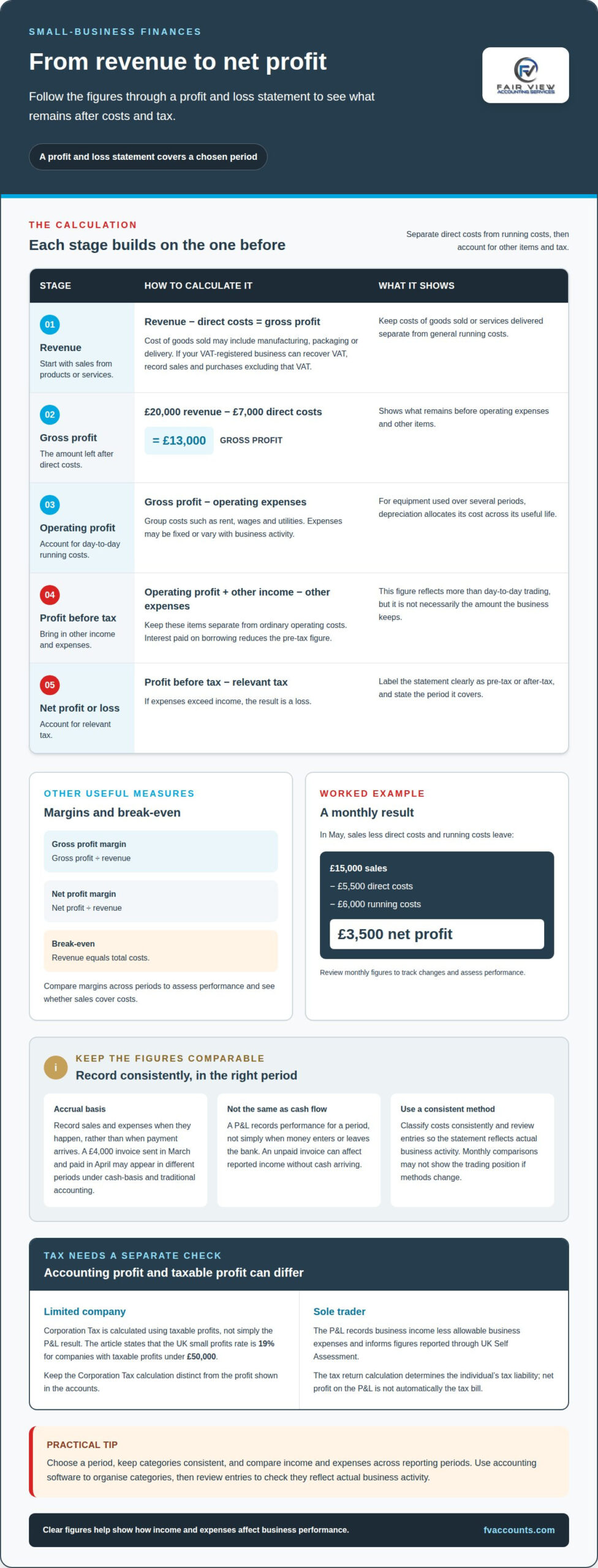
Subtract cost of goods sold from revenue to calculate gross profit. For example, £20,000 revenue minus £7,000 direct costs leaves £13,000 gross profit. This shows what remains before operating expenses and other items. Check that costs relate to goods sold or services delivered, rather than including general running costs at this stage.
-
Work out operating and net profit
Subtract operating expenses from gross profit to find operating profit. Add other income and subtract other expenses to calculate profit before tax, then subtract tax to reach net profit. If expenses exceed income, the result is a loss. Accounting software can organise categories, but review entries to ensure the statement reflects actual business activity.
-
Calculate profit margins and assess performance
Divide gross profit by revenue to find the gross profit margin; divide net profit by revenue for the net profit margin. Compare margins across periods to assess performance. Break-even occurs when revenue equals total costs. These calculations help you see whether sales cover costs and support continued trading.
Operating expenses and other income or expenses
Classify costs consistently so each period gives a comparable view of business performance. Then separate operating results from other items to calculate the net figure.
-
Record sales and expenses on an accrual basis
Record sales and expenses in the period they happen, rather than when payment arrives, under normal accounting rules. For example, a £4,000 invoice sent in March and paid in April may appear in different periods under cash-basis and traditional accounting. Apply the same method consistently, or monthly comparisons may not show the actual trading position.
-
Account for operating expenses and depreciation
Group business running costs, such as rent, wages and utilities, as operating expenses. These may be fixed or vary with business activity. For equipment used over several periods, depreciation allocates its cost across its useful life rather than recording the full purchase as one period’s expense. Apply the same treatment consistently so figures remain comparable.
-
Include other income and expenses
After operating profit, add other income and subtract other expenses to find profit before tax. Keep these separate from ordinary operating costs to show what came from trading and what came from other activity. For example, interest paid on borrowing reduces the pre-tax figure, even though it isn’t a day-to-day operating cost.
-
Assess the effect on net profit or loss
Compare the remaining balance after expenses with revenue for the same period. In May, £15,000 sales less £5,500 direct costs and £6,000 running costs gives £3,500 net profit. If costs exceed the income available, the result is a loss. Reviewing monthly figures through management accounts support can help owners track changes and assess performance.
Calculating net profit or loss after tax
Start with profit before tax and account for the relevant tax. The final figure shows what remains after these deductions.
- Start with profit before tax, after operating costs and other income or expenses. Keep this figure distinct from cash flow: an unpaid invoice can affect reported income without money entering the bank. A balance sheet, by contrast, shows assets and liabilities at a particular point in time.
- For a limited company, calculate Corporation Tax using taxable profits, not simply the P&L result. According to HM Revenue & Customs, the small profits rate of UK corporation tax is 19% for companies with taxable profits under £50,000. The taxable figure and accounting profit can differ.
- Subtract the relevant income tax from profit before tax to calculate net profit after tax. For example, a bakery’s monthly profit is £2,380 after £50 loan interest and estimated Corporation Tax of £570. Treat estimates as provisional until the tax calculation is complete.
- A sole trader’s P&L records business income less allowable business expenses and informs the figures reported through UK Self Assessment. The tax return calculation determines the individual’s tax liability, so net profit on the P&L is not automatically the tax bill. Keep records supporting income and costs, including goods sold and selling expenses.
- Label the statement clearly as pre-tax or after-tax and state the period it covers. This helps you compare trading results with the amount remaining after tax. Limited companies should keep Corporation Tax calculations distinct from the profit shown in their accounts.
Fair View Accounting Services: Accountants for start up businesses
Fair View Accounting Services supports start-up businesses with accounting as they organise financial records and review performance. Accurate profit and loss figures help you understand how income and expenses affect your business, while keeping day-to-day records in order.
An accountant can help prepare Annual Accounts and work through Corporation Tax. Both tasks rely on clear financial records, and organised figures make it easier to connect trading results with your reporting responsibilities. An Accountant’s Certificate may also be relevant when formal confirmation of accounts is required.
Support can be useful as your business moves from early trading into regular reporting. Contact Fair View Accounting Services to discuss accounting support for your start-up.
Put your figures to work
Use your figures as a decision-making tool, not just a record of past trading. Understanding how to calculate profit and loss for a small business gives you financial context for choices about pricing, hiring, investment and growth. Consider what the figures mean in light of your business aims and circumstances.
Build a consistent review habit around the questions that matter: which activities support your objectives, where costs are changing, and what information you need before committing resources. A clear process turns accounts into practical input for your next steps. Fair View Accounting Services can help keep your accounting organised as your needs develop.
A consistent approach can help you move forward with greater clarity.
Frequently Asked Questions
What is profit?
Profit is the amount left when a business’s income exceeds its expenses over a stated period. It can be assessed at different stages: gross profit reflects direct trading costs, while net profit includes wider costs and tax. A positive figure does not necessarily mean the same amount is available in the bank.
How do you calculate P&L?
To calculate a P&L, organise income and expenses for the same reporting period, then subtract costs from income. Separate direct costs, operating expenses and other items to see how each affects the result. If total expenses exceed income, the statement shows a loss. Use consistent categories when comparing periods.
How do you create a P&L?
Create a P&L by choosing a reporting period, gathering the relevant accounting records and grouping income and expenses into clear categories. Professional services such as mcconnellbookkeeping.com can assist with monthly reconciliations and accurate financial statements, while accounting software can produce a statement from recorded transactions. Review how entries are classified, as a consistent layout makes it easier to compare periods and investigate changes without searching through individual transactions.
How do you interpret your P&L statement?
Interpret a P&L by comparing income and cost categories across equivalent periods. Identify whether a change comes from sales, direct costs or overheads, then consider its effect on the overall result. Read it alongside other financial records: a P&L describes performance over time, while a balance sheet shows assets and liabilities at a particular point.
How often should you update your P&L statement?
Update your P&L regularly, for example monthly or quarterly, to maintain a useful view of performance. Monthly figures can help you spot changes in sales, purchases and resourcing sooner, while quarterly reviews provide a broader view. Choose a regular schedule and stick to it so comparisons reflect meaningful periods rather than uneven reporting intervals.
Disclaimer
The information provided in this article is for general guidance only and is not intended to constitute professional advice, tax advice, financial advice, legal advice, or any other form of regulated guidance. Although every effort has been made to ensure accuracy at the time of publication, Fair View Accounting Services, including its director, employees, contractors, writers, and content-creation team, accepts no responsibility for any loss, damage, penalty, or consequence arising from reliance on the information contained herein.
UK tax legislation changes frequently, and HMRC interpretations, thresholds, and rules may vary depending on the individual circumstances of each taxpayer. Nothing in this article should be considered a substitute for obtaining formal, personalised advice from a qualified accountant or tax professional. Readers should not take action or refrain from taking action based solely on the content published on this website.
Fair View Accounting Services does not guarantee the completeness, accuracy, or ongoing validity of the information provided and assumes no liability for omissions or errors, whether typographical, factual, or technical. By using this content, the reader acknowledges that all responsibility for decisions remains solely with the user.