

Could the way you pay yourself affect your tax bill and National Insurance position? Tax-efficient ways to take money from a limited company often involve balancing a director’s salary with dividends. Salary is paid through PAYE and may be subject to Income Tax and National Insurance, while dividends are paid from profits after Corporation Tax and do not attract National Insurance.
The right balance depends on your income and the company’s available profits. This guide explains how salary and dividends work, when each may be suitable, and the tax and National Insurance points to consider. It also covers practical ways to record payments accurately and make decisions that reflect your circumstances. Tip: Keep clear records of salary and dividend payments.
Key Takeaways and Tips
- Understand why dividends are not subject to National Insurance, and how dividend tax can still apply.
- Weigh a director’s salary against its tax and National Insurance effects, including its role in building qualifying years.
- Keep director’s loans distinct from salary and dividends, and learn why repayment timing matters.
- See how dividend paperwork and the annual allowance affect payments, and when accounting support can help you plan and report them.
1. Do I pay National Insurance on dividends?
No. Dividends from a UK company are paid from profits remaining after Corporation Tax and do not attract National Insurance. Salary is different: it goes through PAYE and may be subject to Income Tax and National Insurance for both the director and the company.
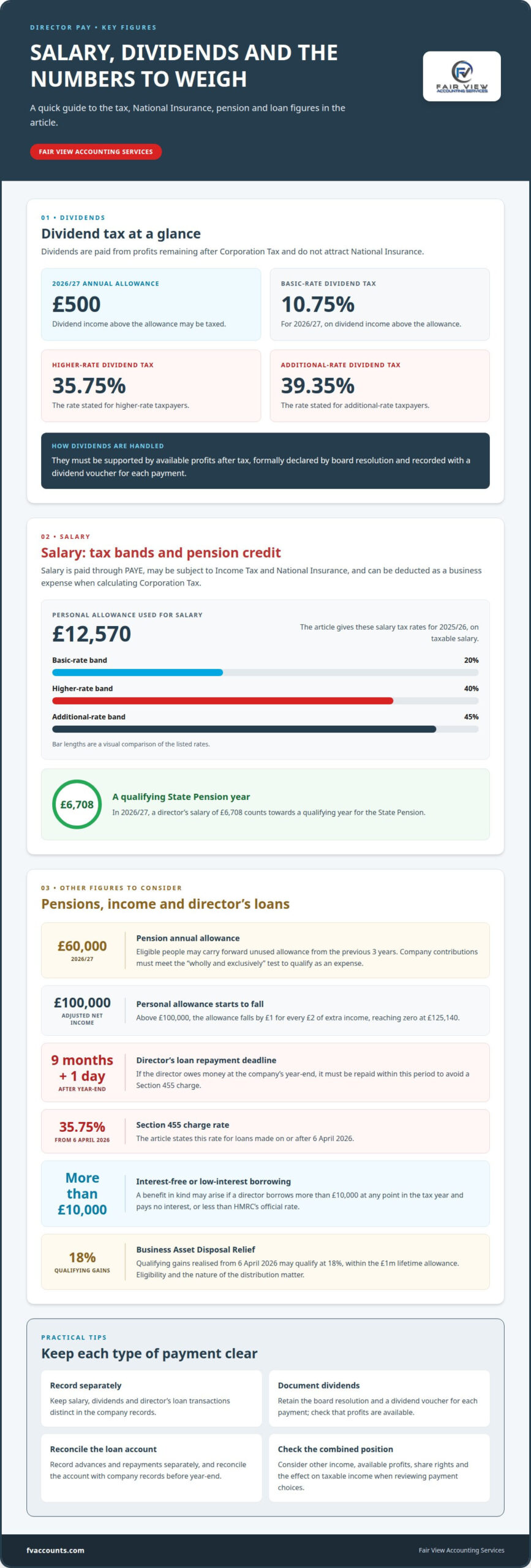
For 2026/27, the annual dividend allowance is £500, according to HM Revenue & Customs. Above it, the basic dividend tax rate is 10.75% for the 2026/27 tax year, according to HM Revenue & Customs. Higher-rate taxpayers pay 35.75%, while additional-rate taxpayers pay 39.35%. By comparison, salary uses the £12,570 personal allowance; for 2025/26, taxable salary is taxed at 20% in the basic-rate band, 40% in the higher-rate band and 45% in the additional-rate band.
For a sole director, a salary-and-dividend mix may help balance PAYE and National Insurance with dividend tax. Family shareholders may receive dividends if they own shares, subject to available profits and the rights attached to those shares. Higher-rate taxpayers should consider how dividends add to their taxable income. Employer pension contributions are another option to compare: qualifying contributions can be a company expense and do not incur Income Tax or National Insurance when paid, but they remain pension savings rather than cash available immediately.
Dividends must be supported by available profits after tax, formally declared by board resolution, and documented with a dividend voucher for each payment. Include taxable dividend income in your Self Assessment and meet the deadline for your return. Keep dividend records with the company accounts. Record dividend payments separately from salary so each is reported correctly; for directors seeking broader guidance on reporting standards and tax strategies, professional practices such as CJ Business Solutions, LLC provide comprehensive accounting and tax solutions.
2. What are the advantages of paying a director’s salary?
A director’s salary is a recorded payment for work, and the company can deduct it as a business expense when calculating Corporation Tax. In 2026/27, a salary of £6,708 counts towards a qualifying year for the State Pension. The right level depends on company profits, other earnings and the director’s tax band. Comparing tax efficient ways to take money from limited company profits can help identify how salary fits alongside dividends and pension contributions.
A director’s loan is different from salary. The director’s loan account records money the company lends to its director, or money the director lends to the company. Record each advance and repayment separately. If the director owes money at the company’s year-end, HM Revenue & Customs says it must be repaid within 9 months and 1 day to avoid a Section 455 charge. For loans made on or after 6 April 2026, the charge rate is 35.75%.
A benefit in kind may arise if a director borrows more than £10,000 at any point in the tax year and pays no interest, or less than HMRC’s official rate. Record the balance and interest charged. Repaying a loan doesn’t turn it into salary, so clear documentation matters. Reviewing tax efficient ways to take money from limited company earnings also means keeping loans separate from personal pay and company expenses.
Using company funds personally without recording the transaction can leave an unexplained loan balance. Treating a payment as a dividend without available profits and proper records can create tax and repayment problems. A practical tip is to reconcile the loan account with company records before year-end. Discuss director’s loan and company accounts support if balances or repayments are unclear.
3. How do dividends work for limited company directors?
Share ownership determines who may receive dividends, so a spouse must hold shares to receive them as a shareholder. The company’s profits and share rights shape how distributions can be made. HM Revenue & Customs states the annual dividend allowance is £500 for 2026-27. Amounts above the allowance are taxed according to the recipient’s income tax band. Tax efficient ways to take money from limited company profits should account for each shareholder’s income and rights.
Adjusted net income affects the personal allowance. Above £100,000, it falls by £1 for every £2 of extra income and reaches zero at £125,140. A dividend can raise total income and reduce the remaining allowance. Consider the combined effect before deciding how to distribute profits, especially where a shareholder has other income.
Pension contributions can support longer-term saving, rather than provide immediate personal income. HM Revenue & Customs sets the annual allowance for pension contributions at £60,000 in 2026/27. Eligible people may carry forward unused allowance from the previous 3 years. Company contributions must meet the “wholly and exclusively” test for business purposes to qualify as an expense. Tax efficient ways to take money from limited company funds may therefore include planning for both current income and retirement.
Claim business expenses only when they’re incurred wholly and exclusively for business purposes, and retain records showing their purpose. On winding up, shareholder distributions may be treated as capital rather than dividend income. Qualifying gains realised from 6 April 2026 may qualify for Business Asset Disposal Relief at 18%, within the £1m lifetime allowance. Eligibility and the nature of the distribution matter.
Fair View Accounting Services
Fair View Accounting Services can help you assess how salary, dividends and pension contributions fit your company’s finances and personal tax position. Its tax planning support helps you consider the timing and effect of payments, while Annual Accounts and Corporation Tax services keep company reporting aligned with financial records.
Consider professional support when reviewing available profits, preparing year-end accounts or deciding how to record director payments. Keep salary, dividend and loan transactions clearly documented so each can be considered correctly alongside the company’s accounts and tax obligations.
Plan your next steps with confidence
Choosing tax-efficient ways to take money from a limited company is an ongoing decision, not just a year-end calculation. As your business develops, review how planned spending, retained profits and personal income affect your approach. Keep these plans with up-to-date company records so decisions reflect the business’s current position.
Fair View Accounting Services supports this process with tax planning, Annual Accounts and Corporation Tax work. An Accountant’s Certificate can also provide formal confirmation of financial information where needed. Accurate records and considered advice can help make your next decisions clearer and easier to manage.
Take the next step at a pace that suits your business, with a clearer view of the choices ahead.
Frequently Asked Questions
Have more questions on how money can be withdrawn from your limited company?
The best next step is to identify each planned payment’s purpose and record it correctly. A director’s pay, shareholder distribution, expense repayment and loan are different transactions. Fair View Accounting Services supports businesses in Bolton, Bury, Lancashire, Manchester and London with accounting and tax matters, helping owners understand how company records relate to their decisions.
What are the advantages of paying a director’s salary?
A salary gives the director documented income and helps the company maintain clear payroll records. This can make personal budgeting more predictable than irregular payments. Before setting the amount, consider the company’s cash flow and ongoing commitments, then keep payroll records aligned with actual payments. Review the arrangement if business income or the director’s circumstances change.
Can I take money out as a director’s loan?
Yes, a company can lend money to a director, but the transaction must be recorded in the director’s loan account and managed separately from salary or dividends. A loan exceeding £10,000 at any point in the tax year may create a benefit-in-kind issue if it’s interest-free or charged below HMRC’s official rate. Keep a clear record of advances, interest and repayments.
What about claiming business expenses?
A company can reimburse qualifying business costs, provided the spending is for business purposes and supported by clear records. For example, UK business mileage can be reimbursed at 45p per mile for the first 10,000 miles. Keep receipts and note the business reason for each cost. Separating personal spending from company expenses makes bookkeeping and tax reporting clearer.
What about pension contributions?
Company pension contributions can support longer-term retirement saving, but they aren’t immediate spending money. When pension access is permitted, 25% of an amount taken from a pension pot is tax-free. Access is generally possible from age 55, rising to 57 from 2028. A practical tip is to consider both the contribution and future access rules before treating a pension as part of your income plan.
Disclaimer
The information provided in this article is for general guidance only and is not intended to constitute professional advice, tax advice, financial advice, legal advice, or any other form of regulated guidance. Although every effort has been made to ensure accuracy at the time of publication, Fair View Accounting Services, including its director, employees, contractors, writers, and content-creation team, accepts no responsibility for any loss, damage, penalty, or consequence arising from reliance on the information contained herein.
UK tax legislation changes frequently, and HMRC interpretations, thresholds, and rules may vary depending on the individual circumstances of each taxpayer. Nothing in this article should be considered a substitute for obtaining formal, personalised advice from a qualified accountant or tax professional. Readers should not take action or refrain from taking action based solely on the content published on this website.
Fair View Accounting Services does not guarantee the completeness, accuracy, or ongoing validity of the information provided and assumes no liability for omissions or errors, whether typographical, factual, or technical. By using this content, the reader acknowledges that all responsibility for decisions remains solely with the user.