

Filing a confirmation statement with Companies House is also a recurring obligation. Companies must review their records and file at least one statement every 12 months, and the confirmation statement fee is payable once in each 12-month payment period, according to Companies House.
The statement confirms company information on the public register, and it’s still required when nothing has changed. The annual confirmation statement fee is due only once in each 12-month payment period, even if you submit more than one statement, according to Companies House.
This guide explains what a confirmation statement covers, how to file it online or on paper, and when each fee applies. You’ll also find practical tips for preparing company details, avoiding delays and identifying changes that must be reported separately.
Key Takeaways
- Tip: Submit a confirmation statement even when your registered company details have not changed.
- Learn which company details can be updated through the statement and which changes need to be reported separately.
- Compare online and paper filing, and see how the filing route affects the Companies House fee.
- Find out how Fair View Accounting Services can support related accounting needs, including Annual Accounts and Corporation Tax.
What is the purpose of the confirmation statement?
A confirmation statement confirms whether a company’s details on the public register are accurate. It does not report financial performance: companies file their accounts separately.
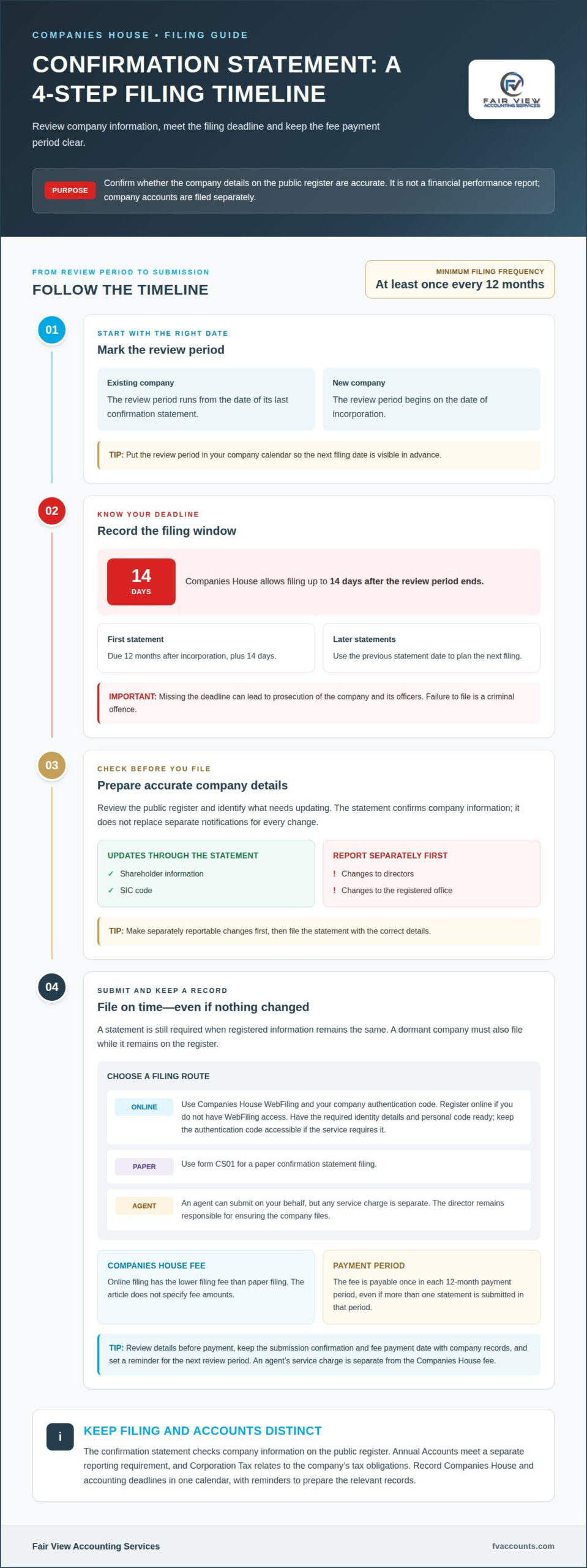
- Mark the review period. Companies registered in the UK must review their records and file at least one confirmation statement every 12 months, and the confirmation statement fee is payable once in each 12-month payment period, according to Companies House. For an existing company, the review period runs from its last confirmation statement. For a new company, it begins at incorporation.
- Record the filing deadline. Companies House allows filing up to 14 days after the review period ends. The first confirmation statement is due 12 months after a company’s incorporation date, plus 14 days; the annual confirmation statement fee is payable once in each 12-month payment period, according to Companies House. Use the incorporation date to plan that first filing; for later filings, use the previous statement date.
- Prepare accurate details before filing. Review the register and identify any information that needs an update. The confirmation statement confirms company information, rather than replacing separate notifications for every change. Before online filing, have the required identity details and personal code ready. Keep the authentication code accessible if the selected online service requires it.
- File by the deadline, even if nothing changed. A company must still submit a statement when its registered information remains the same. Missing the deadline can lead to prosecution of the company and its officers; failure to file is a criminal offence. Submit within the 14-day period after the review period ends to avoid late filing consequences.
Online and paper filing fees
An agent can submit the statement on your behalf, but any service fee is separate from the Companies House filing fee.
-
Choose a filing method
Choose online filing for a direct digital submission, paper filing if you prefer to post the form, or an agent to submit it for you. To file online, use Companies House WebFiling and your company authentication code. If you do not have WebFiling access, register online. Before you start, check that the company details are up to date and follow the relevant Companies House guidance.
-
Compare online and paper fees
These are Companies House filing fees, not charges for an agent to handle the process. An agent may charge separately, so clarify what the service covers and how it is billed before authorising submission. Online filing has the lower Companies House fee.
For an online submission, enter the company details carefully and review them before completing payment. Keep the submission confirmation with your company records, and set a reminder for the next review period. A director remains responsible for ensuring the company files its statement, even when an agent submits it. If coordinating filing with accounting records would help, get support with related accounting tasks.
Companies House filing fees
Plan for the payment period, not the number of statements you submit. Keep the Companies House filing fee separate from any professional charge.
- Track the fee payment period. According to Companies House, a UK company only needs to pay the confirmation statement fee once in each 12-month payment period, even if it files multiple statements during that period. This means an additional statement within the same payment period does not trigger another Companies House fee. Keep the payment date with your company records so you can identify when the next fee falls due.
- Separate the filing fee from help with filing. Companies House charges for submitting the statement; an accountant or agent may charge separately for preparing or filing it. The service charge depends on the work involved, such as reviewing company details or preparing a submission. Ask for a clear breakdown before authorising paid support, and distinguish it from the statutory filing fee.
- Use the confirmation statement for eligible updates. You can update shareholder information or a SIC code through the statement. Changes to directors or the registered office must be reported separately before filing. Make those updates first, then submit the statement with the correct details. Form CS01 is used for paper confirmation statement filings.
- Keep the fee separate from the deadline. The 14-day filing window after a review period ends does not create another fee payment period. A dormant company still needs to file while it remains on the register, so include its filing in your compliance calendar.
Fair View Accounting Services
Fair View Accounting Services helps businesses manage accounting responsibilities alongside their company filing calendar. If preparing a confirmation statement raises questions about financial records or deadlines, our accounting support can help you organise those related responsibilities.
Annual Accounts meet a reporting requirement separate from the confirmation statement, while Corporation Tax relates to the company’s tax obligations. Keeping these tasks distinct helps you plan what information each requires and when it is due. Record Companies House and accounting deadlines in one calendar, with reminders to prepare the relevant records in advance.
Contact Fair View Accounting Services to discuss accounting support for your business.
Keep company records moving forward
Build a routine that connects company administration with the records behind your business decisions. Filing a confirmation statement with Companies House is one part of keeping company information organised; clear financial records also help you prepare for other reporting duties. Set aside time to review company details and supporting records together, so updates stay connected to your wider accounting work.
Fair View Accounting Services provides Accountant’s Certificate, Annual Accounts and Corporation Tax support. These services address separate accounting needs and help you manage related responsibilities alongside company administration.
Discuss the accounting support that fits your business with Fair View Accounting Services.
A consistent approach can make the next administrative task easier to manage.
Frequently Asked Questions
How Much Does It Cost?
The filing fee is separate from any agent’s charge for preparing or submitting a statement. A company pays the annual fee once during its payment period, even if it submits multiple statements. An additional filing in that period does not mean paying the fee again.
When Is Your CS01 Due?
The CS01 is due by the end of the filing window following the company’s review period. For a first statement, Companies House says it is due 12 months after the incorporation date, plus 14 days; the annual confirmation statement fee is payable once in each 12-month payment period. Later deadlines are based on the company’s review period, so use the previous statement date when planning the next submission.
Who is responsible for filing it?
The company’s directors are legally responsible for ensuring the confirmation statement is filed correctly and on time, even when an agent submits it. Delegating preparation or filing does not remove that responsibility. Assign a director to monitor the deadline and keep proof of submission with the company records.
What is a Companies House confirmation statement and who must file one?
A confirmation statement records whether the company information on the public register is accurate. UK companies must file one, including dormant companies that remain on the register. It is separate from annual accounts: the statement concerns registered company details, while accounts report financial information. Treat them as distinct filing tasks to avoid confusing one submission with the other.
When is a confirmation statement due and how can I find the filing deadline?
For the first statement, calculate from the incorporation date; for later statements, use the previous statement’s date to identify the review period. Companies House allows filing up to 14 days after that period ends. To plan filing a confirmation statement with Companies House, record the relevant dates and set a reminder ahead of the deadline, leaving time to prepare accurate information.
Disclaimer
The information provided in this article is for general guidance only and is not intended to constitute professional advice, tax advice, financial advice, legal advice, or any other form of regulated guidance. Although every effort has been made to ensure accuracy at the time of publication, Fair View Accounting Services, including its director, employees, contractors, writers, and content-creation team, accepts no responsibility for any loss, damage, penalty, or consequence arising from reliance on the information contained herein.
UK tax legislation changes frequently, and HMRC interpretations, thresholds, and rules may vary depending on the individual circumstances of each taxpayer. Nothing in this article should be considered a substitute for obtaining formal, personalised advice from a qualified accountant or tax professional. Readers should not take action or refrain from taking action based solely on the content published on this website.
Fair View Accounting Services does not guarantee the completeness, accuracy, or ongoing validity of the information provided and assumes no liability for omissions or errors, whether typographical, factual, or technical. By using this content, the reader acknowledges that all responsibility for decisions remains solely with the user.